
In this article
What Are Nitrosamines and Why Are They Concerning?
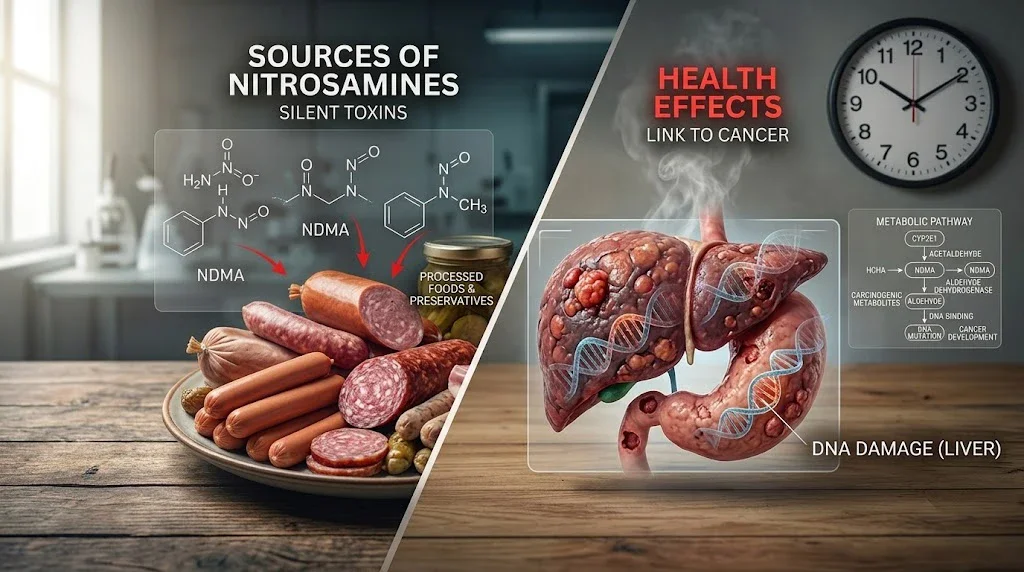
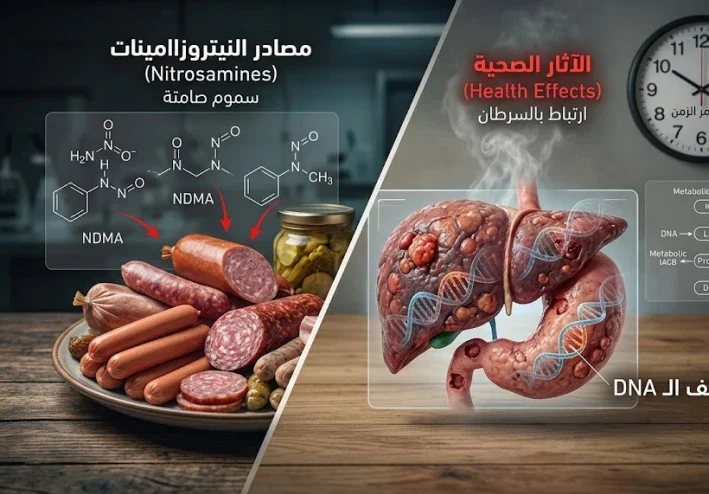
Nitrosamines are not a single chemical substance but a large family of compounds. Some nitrosamines have attracted significant scientific attention because of their ability to cause damage to DNA.
Certain nitrosamines can be metabolized inside the body into highly reactive substances that interact with cells and may damage DNA. If this damage is not properly repaired, genetic mutations can occur. Over time, the accumulation of such mutations may contribute to the development of cancer.
However, it is important to understand that not all nitrosamines have the same level of toxicity or carcinogenic potential. The potential risk depends on the specific compound, exposure level, route of exposure, and duration of exposure.
How Are Nitrosamines Formed?
Some nitrosamines can form when amines react with N-nitrosating agents, including nitrite, under suitable conditions.
This is particularly relevant when studying certain processed foods. Nitrates and nitrites may be used in the production of some processed meats for preservation and to help control the growth of certain bacteria.
Under specific conditions, these substances can contribute to the formation of N-nitroso compounds, a group that includes certain nitrosamines.
Processed Meat and Nitrosamines
Nitrates and nitrites can be found in some processed meat products, including certain sausages and cured meats. Under certain conditions, they may contribute to the formation of N-nitroso compounds.
The International Agency for Research on Cancer (IARC) has classified processed meat as carcinogenic to humans (Group 1) based on available scientific evidence, particularly regarding colorectal cancer.
However, this classification does not mean that eating a single serving of processed meat will cause cancer. Cancer risk is influenced by factors such as amount, frequency, duration of exposure, and individual susceptibility.
Smoking: An Important Source of Nitrosamines
Tobacco products are an important source of a group of compounds known as Tobacco-Specific Nitrosamines (TSNAs).
Among the best-known compounds are:
- NNN – N-Nitrosonornicotine
- NNK – 4-(Methylnitrosamino)-1-(3-pyridyl)-1-butanone
These compounds have been extensively studied because some can be metabolized into reactive substances capable of damaging DNA.
This highlights an important point: the health risks of smoking are not caused by nicotine alone. Tobacco smoke contains a complex mixture of chemicals, including numerous substances known to contribute to cancer.
What About Burned or Charred Food?
This is where an important distinction needs to be made.
It is not scientifically accurate to say that all burned food contains nitrosamines. When food is exposed to very high temperatures or becomes heavily charred, other potentially harmful compounds can form, including acrylamide, heterocyclic amines (HCAs), and polycyclic aromatic hydrocarbons (PAHs).
Burned Bread and Starchy Foods
When carbohydrate-rich foods such as bread and potatoes are cooked at high temperatures, especially during intense browning, acrylamide can form through chemical reactions that occur during heating.
For this reason, regularly consuming severely burned or charred portions of food is best avoided.
Charred Meat and Chicken Skin
Cooking meat and chicken at very high temperatures, particularly over direct flames, can lead to the formation of:
Heterocyclic Amines (HCAs)
and
Polycyclic Aromatic Hydrocarbons (PAHs).
The formation of these compounds can increase with high-temperature cooking, direct flame exposure, and fat dripping onto flames, which can produce smoke that deposits on the food.
Therefore, reducing direct exposure to flames and avoiding heavily blackened or charred portions can help reduce exposure to these compounds.
Nitrosamines, Acrylamide, HCAs, and PAHs: What Is the Difference?
Although these compounds can all be discussed in the context of cancer risk, they are not the same substances and are not formed in exactly the same way.
Nitrosamines:
Can form through nitrosation reactions involving amines and nitrosating agents. Certain types are associated with tobacco products and some foods.
Acrylamide:
Forms mainly when certain carbohydrate-rich foods are cooked at high temperatures, particularly during intense browning.
HCAs and PAHs:
Can form when meat is cooked at high temperatures, especially during grilling, direct flame exposure, and charring.
Therefore, saying that "burned food causes cancer because of nitrosamines" is an oversimplification. A more scientifically accurate statement is that high-temperature cooking and charring can produce different chemical compounds, some of which may pose health risks.
Can Nitrosamine Exposure Be Completely Avoided?
Completely eliminating exposure to all nitrosamines is difficult because these compounds may occur at different levels in various sources.
However, exposure to important sources can be reduced by:
- Avoiding smoking and secondhand tobacco smoke.
- Limiting frequent consumption of processed meats.
- Avoiding heavily charred or blackened portions of food.
- Reducing prolonged direct-flame exposure when grilling meat.
- Maintaining a varied and balanced diet.
The goal is not to fear a single food or chemical but to reduce long-term exposure to well-established sources of harmful substances.
Conclusion
Nitrosamines are a large family of chemical compounds, and some members have established carcinogenic properties. Tobacco products are an important source of certain nitrosamines, while N-nitroso compounds can also form under specific conditions in some foods.
However, nitrosamines are only one part of the broader picture. High-temperature cooking and charring can also produce other compounds, including acrylamide, HCAs, and PAHs.
The most practical approach is therefore to reduce long-term exposure to known carcinogenic sources: avoid smoking, limit processed meat consumption, and avoid heavily burned or charred food.
Cancer is a complex disease influenced by multiple genetic, environmental, dietary, and lifestyle factors. No single meal or chemical exposure automatically means that cancer will develop, but reducing unnecessary exposure to carcinogenic substances is an important part of a healthier lifestyle.
Scientific Sources
- International Agency for Research on Cancer (IARC) – IARC Monographs on the Identification of Carcinogenic Hazards to Humans.
- World Health Organization (WHO) – Tobacco and processed meat information.
- European Food Safety Authority (EFSA) – Risk assessment of N-nitrosamines in food.
- National Toxicology Program (NTP) – Report on Carcinogens.
- IARC – Tobacco-specific nitrosamines and tobacco-related carcinogens.
Keep up with mazen
Choose site notifications, email, or both. Guests can subscribe by email without an account.
Report this article
Tell our review team about a problem with this content. Your details will not be shown to the author or other readers.
Your report could not be sent. Please try again later.
Sign in to report an article








Discussion
comments (0)
Share a perspective. Start a thoughtful conversation.
please login to be able to comment