
في هذا المقال
Passive Smoking: The Hidden Health Risk You May Be Breathing Every Day
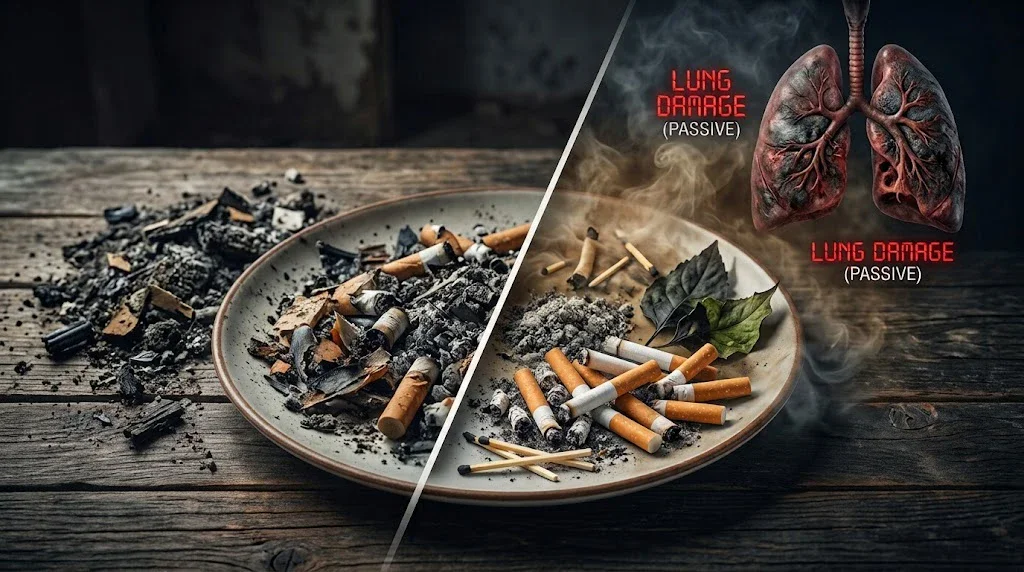
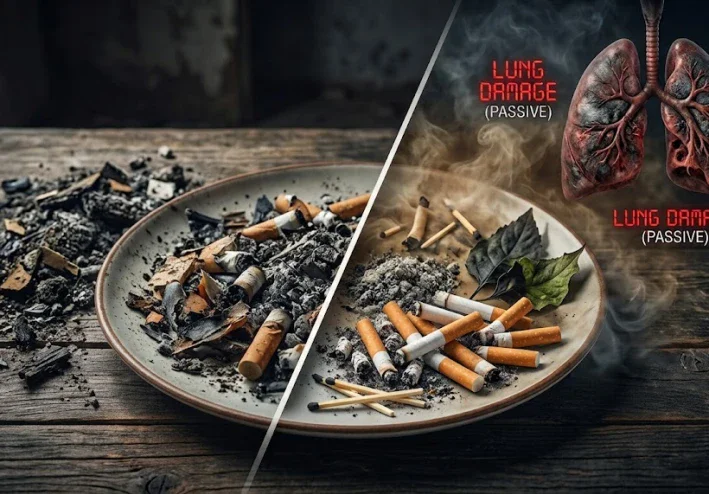
Passive Smoking: When Someone Else’s Smoke Becomes Your Health Problem
You don't have to smoke a cigarette yourself to be affected by tobacco.
Passive smoking, also called secondhand smoke exposure, occurs when a person breathes tobacco smoke produced by another smoker. It can happen at home, in a car, at work, or in other enclosed spaces.
According to the World Health Organization (WHO), secondhand tobacco smoke causes more than 1.3 million premature deaths every year worldwide among nonsmokers.
The danger is easy to underestimate because the exposed person may never feel an immediate effect. But scientific evidence shows that secondhand smoke can affect the lungs, heart, blood vessels, and other organs.
What Is Inside a Cigarette?
A cigarette may look small, but the smoke it produces is chemically complex.
According to the U.S. Centers for Disease Control and Prevention (CDC), cigarette smoke contains more than 7,000 chemicals. Hundreds of these chemicals are toxic, and dozens are known to cause cancer.
Among the harmful substances found in tobacco smoke are carbon monoxide, formaldehyde, benzene, and other toxic compounds.
For the smoker, the exposure is direct: smoke is inhaled into the lungs repeatedly, allowing these chemicals and nicotine to enter the body.
Nicotine is particularly important because it is highly addictive and can lead to tobacco dependence, making it difficult for many smokers to stop even when they understand the health risks.
How Is Passive Smoking Different From Active Smoking?
A person exposed to secondhand smoke generally does not receive the same dose as the person actively smoking. The active smoker inhales smoke directly and repeatedly, while the nonsmoker is exposed to smoke present in the surrounding environment.
But "less exposure" does not mean “safe exposure.”
The CDC states that there is no safe level of exposure to secondhand smoke. Even relatively brief exposure can affect the cardiovascular system, while repeated exposure increases the risk of serious disease.
For nonsmokers, secondhand smoke exposure is associated with an increased risk of coronary heart disease, stroke, and lung cancer.
The CDC estimates that nonsmokers exposed to secondhand smoke have approximately a 25–30% higher risk of developing coronary heart disease.
So while passive smoking and active smoking are not equivalent in dose, passive smoking is still a genuine health risk.
What Happens to the Lungs?
The respiratory system is one of the first areas affected by tobacco smoke.
Secondhand smoke can irritate the airways and worsen respiratory symptoms, particularly in people with asthma.
Children are especially vulnerable because their lungs are still developing. According to the CDC, children exposed to secondhand smoke have an increased risk of respiratory infections, ear infections, more severe asthma symptoms, and impaired lung development.
This means that a child sitting in a smoky room is not simply breathing an unpleasant odor. Their developing lungs are being exposed to toxic substances.
Passive Smoking and Heart Health
The damage isn't limited to the lungs
Secondhand smoke can affect blood vessels and cardiovascular function. Long-term exposure is associated with an increased risk of coronary heart disease and stroke.
This is particularly important because cardiovascular disease may develop gradually without obvious symptoms.
The absence of immediate symptoms does not mean that exposure has no biological effect.
What About Pregnancy?
Secondhand smoke is also a concern during pregnancy.
Exposure to tobacco smoke during pregnancy has been associated with adverse outcomes, including low birth weight and other risks to the developing baby.
For this reason, pregnant women should avoid environments where tobacco smoke is present whenever possible.
A smoke-free home and car are particularly important during pregnancy.
Children Are Among the Most Vulnerable
Adults can sometimes choose to leave a smoky environment. Children often cannot.
Secondhand smoke exposure in children has been associated with:
- More frequent and severe asthma attacks
- Respiratory infections
- Ear infections
- Reduced lung growth
- Increased risk of sudden infant death syndrome (SIDS)
This makes smoking inside homes and cars particularly dangerous for families with children.
One Cigarette vs. Secondhand Smoke: Is the Exposure the Same?
A common misconception is that passive smoking is essentially the same as smoking a cigarette yourself.
It isn't.
The dose of smoke received by a nonsmoker is generally lower than that received by an active smoker. However, secondhand smoke contains many of the same toxic and carcinogenic substances.
The important distinction is therefore not whether the exposure is identical, but whether it carries risk.
And the scientific answer is clear: yes, it does.
What About Hookah? Is One Hookah Session Equal to 100 Cigarettes?
This is one of the most commonly repeated claims about smoking.
You may have heard:
«"One hookah session equals 100 cigarettes."»
But scientifically, this statement is too simplistic.
A hookah session can last much longer than smoking a single cigarette, and the amount of smoke inhaled can be dramatically greater.
The CDC notes that during a typical one-hour hookah session, a person may inhale approximately 90 liters of smoke, compared with roughly 0.5–0.6 liters of smoke from a single cigarette.
That means the volume of smoke inhaled during a hookah session can be equivalent to dozens of cigarettes in terms of smoke volume alone.
But this does not mean that one hookah session is scientifically equal to a fixed number of cigarettes in terms of overall health damage.
Why?
Because actual exposure depends on several factors, including:
- Duration of the hookah session
- Amount and type of tobacco used
- Type and amount of charcoal
- Smoking technique
- Depth and frequency of inhalation
There is another important difference: the charcoal used to heat hookah tobacco produces carbon monoxide and other toxic substances, adding another source of harmful exposure.
So the correct conclusion isn't “one hookah equals exactly X cigarettes.”
The more scientifically accurate conclusion is:
A hookah session can expose a person to a very large volume of smoke and significant amounts of toxic chemicals, and hookah smoking is not a safe alternative to cigarettes.
Can Opening a Window Protect You?
Many people believe that smoking next to a window, using a fan, or smoking in another room completely eliminates secondhand smoke.
Unfortunately, these measures are not reliable ways to eliminate exposure.
Smoke can spread through indoor air, and toxic particles can remain in the environment.
The most effective solution is simple:
Keep homes and vehicles completely smoke-free.
If someone needs to smoke, smoking outdoors and away from doors, windows, and children is preferable to smoking indoors.
The Smoke You Don't See Can Still Hurt You
Passive smoking is easy to ignore because it doesn't always produce an immediate warning sign.
But the scientific evidence is clear: secondhand smoke contains toxic and carcinogenic chemicals and is associated with serious cardiovascular and respiratory health risks.
Active smokers generally receive a higher dose of tobacco smoke, but that does not make secondhand exposure harmless.
And when it comes to hookah, don't rely on viral claims that a session is "exactly equal to 100 cigarettes." The reality is more complicated—but that complexity does not make hookah safe.
You don't have to be the person holding the cigarette to be affected by tobacco smoke.
Creating smoke-free homes, cars, workplaces, and public spaces is one of the most effective ways to protect nonsmokers, particularly children and pregnant women.
Scientific Sources
- World Health Organization (WHO) — Tobacco
https://www.who.int/news-room/fact-sheets/detail/tobacco
- Centers for Disease Control and Prevention (CDC) — About Secondhand Smoke
https://www.cdc.gov/tobacco/secondhand-smoke/
- Centers for Disease Control and Prevention (CDC) — Hookahs
https://www.cdc.gov/tobacco/other-tobacco-products/hookahs.html
- National Cancer Institute (NCI) — Secondhand Smoke and Cancer
https://www.cancer.gov/about-cancer/causes-prevention/risk/tobacco/second-hand-smoke-fact-sheet
تابع جديد mazen
اختر إشعارات الموقع أو البريد أو الاثنين. الزائر يقدر يشترك ببريده دون تسجيل حساب.
الإبلاغ عن المقال
لو لاحظت مشكلة في المحتوى، أرسلها لفريق المراجعة. لن تظهر بياناتك لكاتب المقال أو للقراء.
تعذّر إرسال البلاغ الآن. حاول مرة أخرى لاحقًا.
سجّل الدخول لإرسال بلاغ








النقاش
التعليقات (0)
فكرة تضيفها، أو سؤال يفتح حوارًا.
الرجاء تسجيل الدخول لتتمكن من التعليق