

في هذا المقال
Your phone charges overnight, then its battery powers it all day with no cable attached. It feels ordinary, but if you ask how a battery actually stores electricity, the common answer is wrong. A battery does not store electricity the way a tank stores water. It stores energy as chemical materials, and converts that energy into electricity on demand. Understanding that difference is the key to everything about batteries.
The basic ingredients
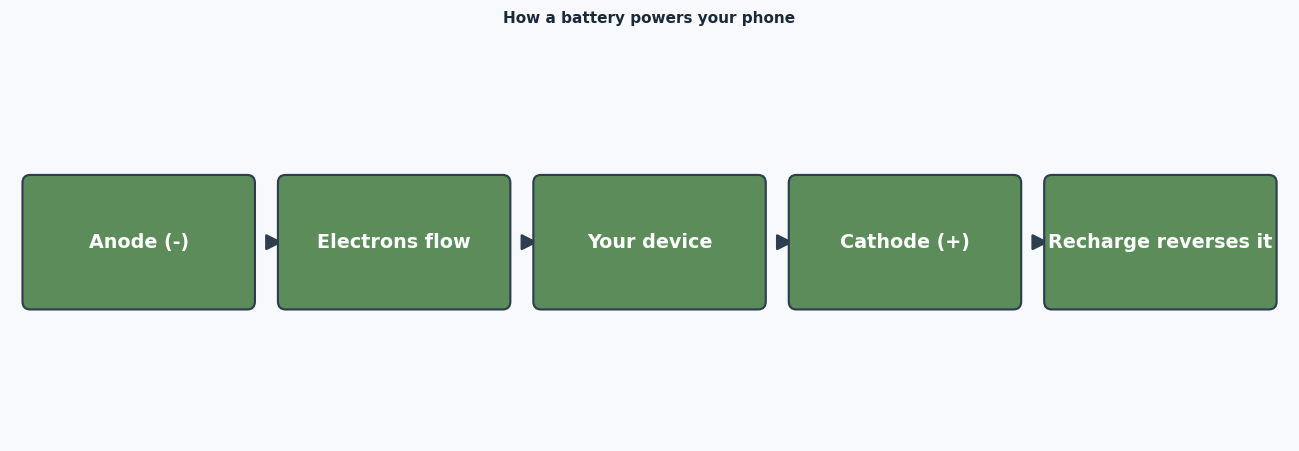
Every battery has three main parts: a positive electrode, a negative electrode, and a middle substance called the electrolyte. The two electrodes are made of different chemical materials. One holds plenty of electrons ready to move, and the other is eager to accept them. Nature prefers balance, so the electrons are always ready to migrate from one side to the other.
But the electrolyte between the electrodes does not let electrons pass directly through the battery. The only path available to them is the external circuit, meaning the wire and the device connected between the two ends. That is where the battery does its job: electrons flow through the circuit to reach the other electrode, and that flow is the electric current that runs your phone.
Why does it run out, and why does charging reverse it?
As more electrons migrate, the chemical materials inside the battery gradually change. The material that gave electrons has given them all, and the receiving material is full. When the reaction completes, the battery is empty, and there is no voltage left to push new electrons.
In rechargeable batteries like the lithium-ion one in your phone, that reaction is reversible. When you plug in the charger, the incoming electricity pushes the electrons and materials back to their original state, so the battery becomes charged again. Charging stores no electricity; it resets the chemistry.
Why lithium rules them all
Lithium-ion batteries power phones, laptops and electric cars for one simple reason: lithium is the lightest metal in nature, and it delivers a lot of energy for its weight. A small, light battery can run your device for a full day. That efficiency is called energy density, and no other material has beaten lithium commercially so far.
Researchers are working on the next generation, solid-state and sodium batteries, which may charge faster, cost less and be safer. But until they arrive, the battery in your pocket keeps working on the same basic idea invented more than two hundred years ago: chemical energy that turns into electricity exactly when you need it.
## Why batteries lose life over the years
If you have noticed that an old phone does not last the day like it used to, that is another chemical story. With every charge and discharge cycle, tiny unwanted side reactions slowly damage the electrodes and trap some of the moving lithium. The battery does not leak electricity; it gradually loses the materials that can still move. That is why capacity fades after a few hundred cycles, and why keeping a battery between roughly twenty and eighty percent, away from heat, slows the aging down.
تابع جديد Abdo Nour
اختر إشعارات الموقع أو البريد أو الاثنين. الزائر يقدر يشترك ببريده دون تسجيل حساب.
ادعم الكاتب
أعجبك المقال؟ أرسل هدية إلى Abdo Nour
هديتك تصل إلى الكاتب مباشرة وتتحول إلى أرباح في محفظته.
كن أول من يدعم هذا المقال بهدية 💝
link_questionالإبلاغ عن المقال
لو لاحظت مشكلة في المحتوى، أرسلها لفريق المراجعة. لن تظهر بياناتك لكاتب المقال أو للقراء.
تعذّر إرسال البلاغ الآن. حاول مرة أخرى لاحقًا.
سجّل الدخول لإرسال بلاغ






النقاش
التعليقات (0)
فكرة تضيفها، أو سؤال يفتح حوارًا.
الرجاء تسجيل الدخول لتتمكن من التعليق