
في هذا المقال
There is a refrigerator in every home, running twenty-four hours a day without anyone paying attention. But think about it for a second: how does a machine that only plugs into the wall, with no ice and nothing cold entering it, keep its inside twenty degrees colder than the room? The answer is one of the smartest engineering ideas serving you every day: a fridge does not create cold, it moves heat.
The core idea: evaporation cools
Try putting a little alcohol on your hand; you will feel instant coolness. That happens because when alcohol evaporates, it pulls heat from your skin to turn from liquid into gas. The physics rule is simple: any liquid that evaporates must absorb heat from its surroundings. The entire refrigerator is built on that one sentence.
Inside the fridge there is a refrigerant, a special fluid designed to evaporate and condense easily at convenient temperatures. This fluid travels in a sealed loop that passes through the inside of the fridge and along its back.
The cycle step by step
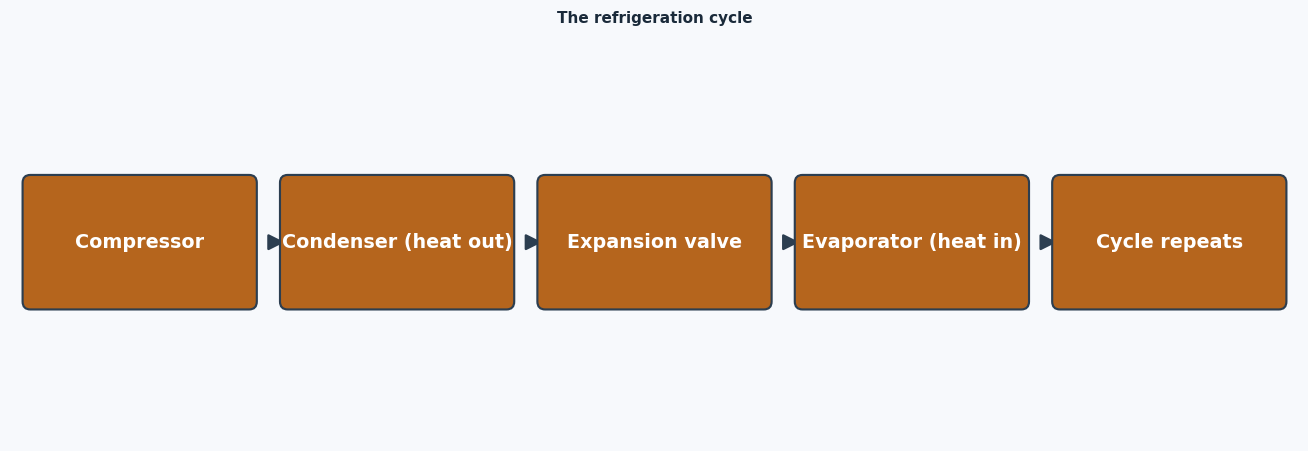
The cycle starts with the compressor, the motor whose hum you hear. The compressor squeezes the refrigerant gas, raising its pressure and temperature. The hot, pressurized gas flows through the coils on the back of the fridge, which feel warm if you touch them, and there it loses its heat to the room and condenses into a liquid.
The pressurized liquid then passes through an expansion valve, a very narrow opening that drops it from high pressure to low pressure suddenly. As the pressure falls, the liquid starts to evaporate, and that evaporation absorbs heat from the surroundings. This part happens inside coils built into the fridge walls, so they pull heat from the food and the air inside. The cool gas returns to the compressor, and the cycle begins again.
The result: heat is pumped from inside the fridge and thrown out the back into your kitchen. That is why the back of a fridge is always warm, and why you should never push it flat against the wall without ventilation space.
Why does the fridge keep switching on and off?
A thermostat inside the fridge constantly measures the temperature. When it reaches the level you set, it switches the compressor off to save electricity. When the temperature rises, whether because you opened the door or put in warm food, it starts the compressor again. That is why the fridge sound comes and goes all day.
From the first home refrigerator about a hundred years ago until today, the idea itself has not changed; only the efficiency improved and the gases became safer for the environment. A simple-looking machine, but behind it is physics working for you every second.
تابع جديد Eng Abdo Mahrous Nour
اختر إشعارات الموقع أو البريد أو الاثنين. الزائر يقدر يشترك ببريده دون تسجيل حساب.
ادعم الكاتب
أعجبك المقال؟ أرسل هدية إلى Eng Abdo Mahrous Nour
هديتك تصل إلى الكاتب مباشرة وتتحول إلى أرباح في محفظته.
كن أول من يدعم هذا المقال بهدية 💝
link_questionالإبلاغ عن المقال
لو لاحظت مشكلة في المحتوى، أرسلها لفريق المراجعة. لن تظهر بياناتك لكاتب المقال أو للقراء.
تعذّر إرسال البلاغ الآن. حاول مرة أخرى لاحقًا.
سجّل الدخول لإرسال بلاغ







النقاش
التعليقات (0)
فكرة تضيفها، أو سؤال يفتح حوارًا.
الرجاء تسجيل الدخول لتتمكن من التعليق