
In this article
The Waraq and Moneeb Mystery: An Unidentified Body and 90 Days Searching for Answers
Seven body parts, a suitcase left on a busy street, and a missing head. After weeks of investigation, the central question remained unanswered: Who was the man, and who killed him?
Many criminal investigations begin with a witness, a security camera, or a missing-person report that leads investigators toward a suspect. The Waraq and Moneeb case presented a more difficult challenge: investigators had clear evidence of a serious crime, but they did not know the victim’s identity.
There was no confirmed name to help them trace the man’s final movements, contact his relatives, or identify the people he had met before his death. Even after additional remains were discovered in another location, the mystery remained.
The case took place in Giza, Egypt, in 2017. Egyptian news reports documented the discovery of human remains, forensic examinations, and searches through missing-person reports. In December of that year, Al-Watan reported that the case had been archived against an unknown perpetrator.
How did the investigation begin? What did the evidence actually establish? And why did the discovery of physical remains fail to reveal the victim’s identity?
A suitcase on Teraa Al-Sawahil Street
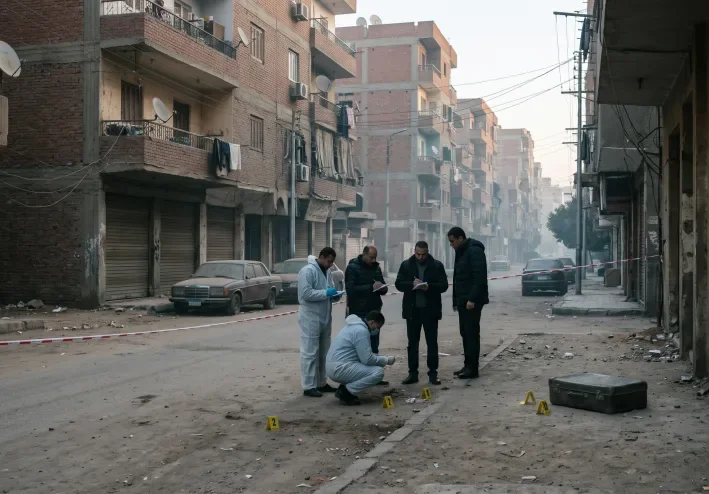
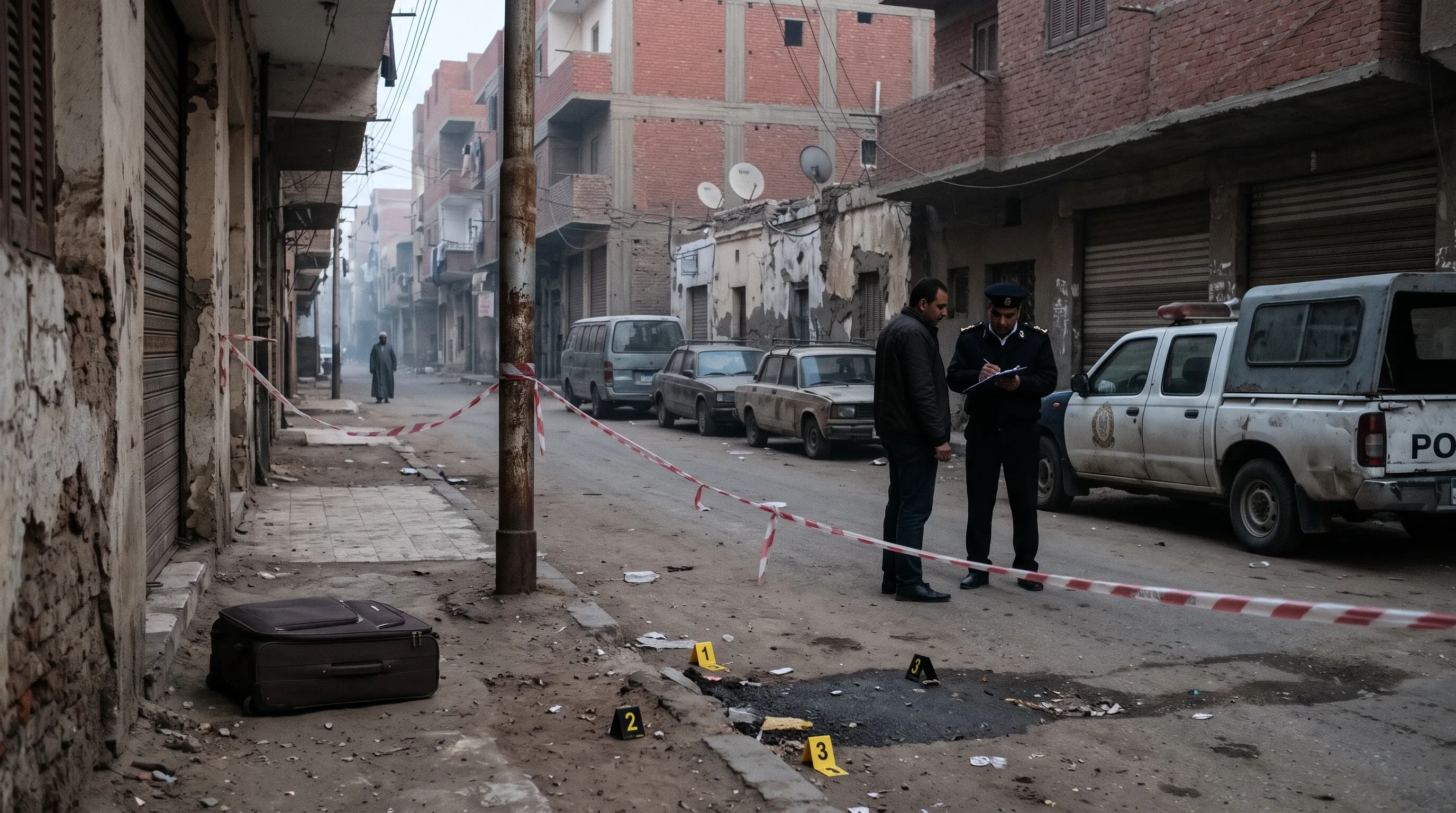
On the morning of Monday, August 7, 2017, residents discovered a suitcase abandoned on Teraa Al-Sawahil Street in the Waraq Arab area of northern Giza.
At first, the suitcase appeared to be an ordinary object left in a busy street. But inside were three plastic bags containing human remains. The discovery was reported to the police, and investigators and prosecutors arrived at the scene.
The initial examination established that the remains belonged to a man. News reports stated that the body had been divided into parts and that the head and neck were missing.
The victim’s identity was unknown. No reliable eyewitness came forward with information that could identify the person who had left the suitcase or establish where that person had gone.
According to an Al-Watan report published on August 7, investigators examined nearby businesses for surveillance footage, but the search did not produce a clear recording that identified the person who had left the suitcase. Authorities also began reviewing missing-person and kidnapping reports in nearby areas.
The investigation faced two immediate questions: Who was the victim, and where were the remaining parts of the body?
Additional remains discovered near Moneeb
The investigation did not end with the suitcase. Approximately six hours after the initial discovery, two additional parts of the body were found near Moneeb Metro station.
The case now involved two locations in Giza: Waraq, where the suitcase and the first remains had been discovered, and Moneeb, where additional remains were found.
This development allowed investigators to examine the discoveries together. Later news reports stated that the seven recovered parts belonged to one person, while the head remained missing.
However, finding the remaining parts did not reveal the victim’s name. Investigators had physical evidence to examine, but they still lacked a confirmed identity that could lead them to the man’s family or help establish his final movements.
What did the DNA examination establish?
On August 12, 2017, Al-Watan published a report about the results of DNA testing. According to the newspaper, the forensic examination established that the remains found in Waraq and Moneeb belonged to one person. The body had been recovered in seven parts.
This was an important forensic finding because it answered a specific question: the remains discovered at the two locations belonged to the same victim.
But establishing that samples belong to one person is not the same as identifying that person or determining who killed him.
DNA testing can help match biological samples to a known individual when a suitable reference sample is available. It does not automatically reveal a victim’s name when no reliable comparison information exists.
Later reports stated that investigators had still not identified the victim. It would therefore be inaccurate to claim that the DNA result identified the man or revealed the killer. The reported result connected the recovered remains; it did not, by itself, solve the murder.
The investigation then faced its most difficult task: discovering who the victim had been before he became an unidentified murder victim.
Searching missing-person reports for a name
Investigators reviewed missing-person and kidnapping reports in several nearby areas, including Waraq, Imbaba, and Osim.
In theory, the process was straightforward. A family might have reported a missing man whose age and physical characteristics matched the victim. If investigators could establish his identity, they might be able to reconstruct his recent movements, identify people he had met, and understand the circumstances surrounding his disappearance.
In practice, the search was difficult. Information about the victim was limited, and his head was among the missing parts. The reports available at the time did not establish a confirmed match between the remains and a missing person whose family had filed a report.
Investigators also lacked a reliable eyewitness who could identify the person who had left the suitcase. News coverage did not report a clear surveillance recording that revealed that person’s identity.
The investigation therefore relied on physical evidence and inquiries that, according to later reporting, did not produce a confirmed name.
The missing head: an important detail, but not a complete answer
One of the most striking details of the case was that the victim’s head and neck were not recovered.
In some investigations, the head can help establish identity through facial features, dental records, or other methods. Its absence can make identification more difficult, but it does not necessarily make identification impossible. Fingerprints, DNA, distinctive physical features, and medical records may also help investigators identify a victim.
In this case, however, the missing head and the absence of a reliable eyewitness added to the investigative challenge.
It is important not to draw conclusions beyond the evidence. The absence of the head does not, by itself, establish a particular motive or prove that the killer intended to prevent identification. Such claims would require independent evidence.
After weeks of investigation, the case remained unresolved
On October 24, 2017, Al-Watan reported that investigators were still trying to establish the victim’s identity, more than two months after the remains had been discovered.
On December 26, 2017, the newspaper published a report titled “A Complete Crime in Waraq: 90 Days Searching for the Killer and the Victim’s Head.” It stated that investigators had not identified the victim or the perpetrator and that the prosecution had archived the case against an unknown person.
This is the key point in the reported investigation: the published account did not identify a person whose responsibility for the crime had been established.
Archiving a case against an unknown perpetrator does not mean the crime never happened. It also does not prove that authorities knew the killer’s identity and concealed it. In the context of the report, it means that investigators had not identified a perpetrator to whom the crime could be attributed.
The report reflects what was published at the time. It is not sufficient, by itself, to establish whether the legal status of the case changed in later years. The sources reviewed for this article did not provide a reliable later update confirming the victim’s identity or the perpetrator.
Did the investigation uncover another murder?
Some news coverage described a separate murder that reportedly emerged during inquiries connected to the search for the perpetrator in the Waraq case. Other reports discussed a driver who had been killed and whose body had been concealed.
These accounts must be treated cautiously. They do not justify merging the two crimes into a single narrative, nor do they establish that the unidentified victim in the Waraq and Moneeb case was the same person as the victim in the driver’s murder.
For that reason, the separate account should not be presented as the solution to the original case. Nor should anyone mentioned in reporting about the other incident be described as responsible for the Waraq and Moneeb murder without evidence establishing that connection.
Investigations can uncover separate crimes while searching for answers to an existing case. Similar methods of concealing or dismembering a body do not, by themselves, prove that two crimes are connected.
Why the case could inspire a crime film or series
The most compelling part of the Waraq and Moneeb case is not simply the discovery of the remains. It is the way the investigation gradually established some facts while leaving other questions unanswered.
A film could begin with an ordinary suitcase abandoned on a busy street. Investigators then discover additional remains near a metro station and use forensic examination to establish that the recovered parts belong to one person. They search missing-person reports and look for witnesses, trying to establish the victim’s identity.
Each stage answers one question while raising another. The remains belong to one person, but who was he? Investigators have physical evidence, but can they establish the victim’s name? Missing-person reports are being reviewed, but is there a reliable match?
A realistic adaptation could end where the documented evidence ends, without inventing a killer, a motive, or a confession that the available sources do not establish.
The case would suit a restrained investigative drama built around evidence, uncertainty, and the limits of an investigation—not graphic violence or exaggerated horror.
What do we actually know?
News reports confirm that human remains were found in Waraq, followed by additional remains near Moneeb. Reports published in August 2017 stated that the seven recovered parts belonged to one person. Later reporting stated that investigators had not identified the victim or the perpetrator and that the case was archived against an unknown person at the end of 2017.
The victim’s identity, the motive for the killing, the identity of the person who left the suitcase, and the location where the original crime occurred were not conclusively established in the reports reviewed for this article.
That is what makes the case significant: not every real criminal investigation ends with a complete explanation. Sometimes investigators establish important facts but cannot reach the answer everyone is waiting for.
Seven body parts, two locations in Giza, and a head that was never found. After weeks of investigation, the victim’s name remained unknown in published reports.
The question that remains is simple: Who was this man, and has reliable information emerged since then that could restore his identity and explain what happened to him?
Sources
Al-Watan, August 7, 2017: “The Full Story of the Waraq Suitcase Containing Five Parts of a Young Man’s Body.”
Al-Watan, August 12, 2017: “Forensic Medicine: The Waraq and Moneeb Remains Belong to One Man; Search for the Head Continues.”
Al-Watan, October 24, 2017: “Intensive Efforts to Identify the Human Remains and Find the Missing Head.”
Al-Watan, December 26, 2017: “A Complete Crime in Waraq: 90 Days Searching for the Killer and the Victim’s Head.”
Note: This article describes what Egyptian news reports published in 2017 stated about the case. It does not claim to establish the case’s current legal status.
Keep up with amr khaled
Choose site notifications, email, or both. Guests can subscribe by email without an account.
Report this article
Tell our review team about a problem with this content. Your details will not be shown to the author or other readers.
Your report could not be sent. Please try again later.
Sign in to report an article








Discussion
comments (0)
Share a perspective. Start a thoughtful conversation.
please login to be able to comment