

في هذا المقال
Mercury: The Smallest Planet in the Solar System and the Closest to the Sun
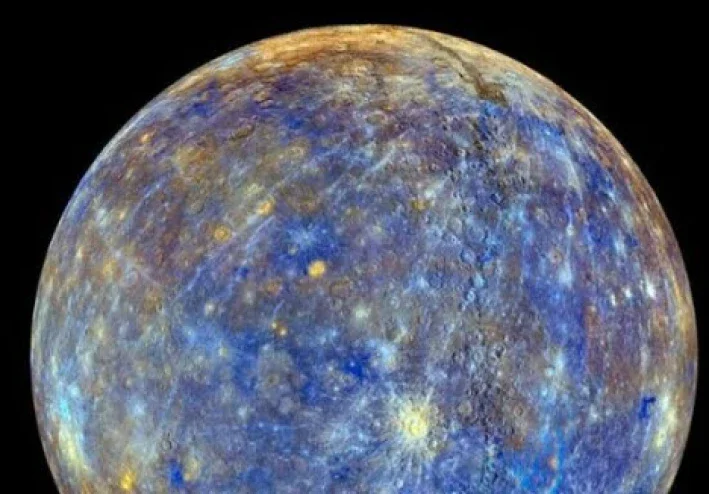
Mercury is the closest planet to the Sun and the smallest planet in the Solar System. Despite its small size, it is a fascinating world full of strange and extreme phenomena. Its surface is extremely hot during the day and incredibly cold at night. Mercury also has a remarkably long day and a very short year.
GENERAL FACTS ABOUT MERCURY
Sidereal day: 59 Earth days
Solar day: 176 Earth days
Length of a year: 88 Earth days
Diameter: 4,879 kilometers, about 38% of Earth's diameter
Average distance from the Sun: 57.9 million kilometers
Mass: 3.30 × 10²³ kilograms
Density: 5.43 g/cm³, making Mercury the second-densest planet in the Solar System after Earth
Surface gravity: 3.7 m/s²
Number of moons: None
WHY IS MERCURY SO EXTREME?
Mercury does not have a thick atmosphere like Earth. Instead, it has an extremely thin exosphere that cannot retain much heat. Because of this, temperatures can change dramatically between day and night.
During the daytime, surface temperatures can reach about 430°C, while at night they can fall to around −180°C.
Interestingly, Mercury is not the hottest planet in the Solar System, even though it is the closest to the Sun. Venus is hotter, with an average surface temperature of about 465°C. Its thick atmosphere traps heat and creates an extremely powerful greenhouse effect.
AMAZING FACTS ABOUT MERCURY
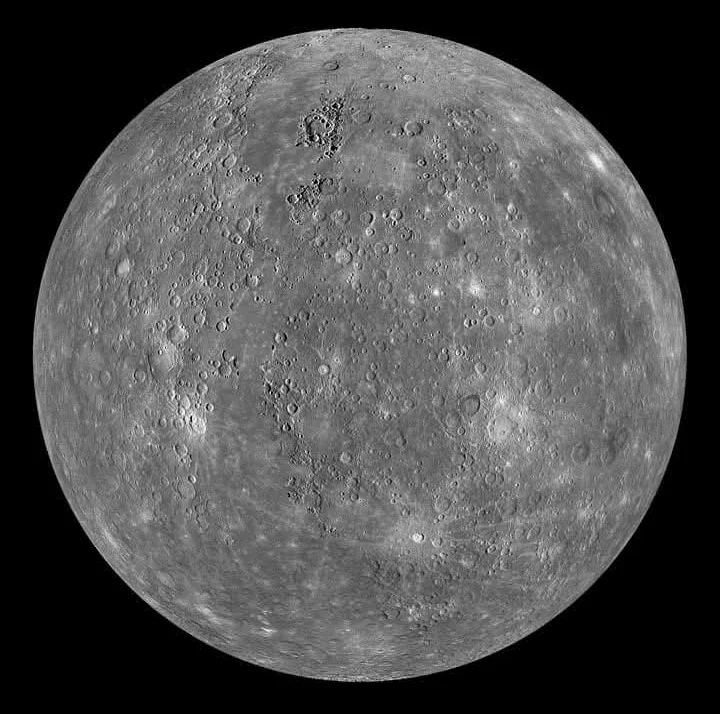
Mercury's surface looks surprisingly similar to the Moon. It is covered with countless craters created by impacts from asteroids and other space objects over billions of years.
One of the most fascinating discoveries about Mercury is the presence of water ice inside some craters near its poles. These areas remain permanently shaded from direct sunlight, allowing the ice to survive despite the extreme temperatures on the rest of the planet. Scientists believe that some of this water may have been delivered by water-rich comets and asteroids.
Another interesting fact is that the sky on Mercury appears dark even when the Sun is above the horizon. This is because Mercury's exosphere is far too thin to scatter sunlight in the way Earth's atmosphere does.
Mercury also has a very unusual sunrise and sunset pattern. In some areas, the Sun can appear to slow down, stop, and briefly move backward across the sky before continuing its normal path. This happens because of the relationship between Mercury's slow rotation and its fast, elliptical orbit around the Sun.
Mercury also has a very large metallic core compared with its overall size. This unusual internal structure is closely related to the planet's global magnetic field.
SPACE MISSIONS TO MERCURY
Only a few spacecraft have visited Mercury because reaching the planet and entering orbit around it is extremely difficult.
Mariner 10 was the first spacecraft to visit Mercury. It was launched in 1973 and flew past the planet three times between 1974 and 1975. The mission provided valuable information about Mercury's surface and helped scientists discover its magnetic field.
MESSENGER was the next major mission to Mercury. Launched in 2004, it became the first spacecraft to enter orbit around Mercury in 2011. It studied the planet until 2015 and helped scientists create an almost complete map of its surface. The mission also provided strong evidence for water ice in permanently shadowed polar craters.
BepiColombo is a joint mission between the European Space Agency (ESA) and the Japan Aerospace Exploration Agency (JAXA). It was launched in 2018 and carries two scientific orbiters designed to study Mercury and its environment.
CONCLUSION
Although Mercury is the smallest planet in the Solar System, it is far from being a simple world. Its close proximity to the Sun, unusual rotation, extreme temperature differences, huge metallic core, and hidden polar ice make it one of the most fascinating planets to study.
As space missions continue to explore Mercury, scientists are discovering more about this small but mysterious world.
تابع جديد مجرة المعرفة Galaxy of knowledge
اختر إشعارات الموقع أو البريد أو الاثنين. الزائر يقدر يشترك ببريده دون تسجيل حساب.
الإبلاغ عن المقال
لو لاحظت مشكلة في المحتوى، أرسلها لفريق المراجعة. لن تظهر بياناتك لكاتب المقال أو للقراء.
تعذّر إرسال البلاغ الآن. حاول مرة أخرى لاحقًا.
سجّل الدخول لإرسال بلاغ







النقاش
التعليقات (0)
فكرة تضيفها، أو سؤال يفتح حوارًا.
الرجاء تسجيل الدخول لتتمكن من التعليق