

In this article
Plastic-Eating Bacteria: How a Microscopic Discovery is Destroying Mountains of Waste
Imagine that the plastic water bottle you drank from today could remain on planet Earth until almost the year 2400 without degrading! Plastic—specifically PET (polyethylene terephthalate)—represents one of humanity's greatest industrial achievements and, at the same time, one of its harshest environmental nightmares. We produce nearly 400 million tons of plastic waste globally every year, with less than 9% of it being recycled, while the rest ends up in oceans and landfills.
But what if I told you that nature decided to evolve a microscopic bacterial "weapon" to eat this plastic and convert it into food in just days instead of centuries?
The Spark of Discovery: The Incredible Japanese Coincidence
This remarkable story began in 2016 when a team of Japanese researchers at Keio University were collecting soil and wastewater samples near a plastic recycling plant in Osaka. The idea was simple: search for microorganisms that had adapted to survive in high concentrations of plastic.
And there lay the surprise! Scientists discovered a completely new bacterial strain, which they named Ideonella sakaiensis 201-F6. This tiny bacterium wasn't just clinging to the plastic surface; it was using it as its primary source of carbon and energy to survive.
Chemical Magic: How Bacteria Digest Solid Matte
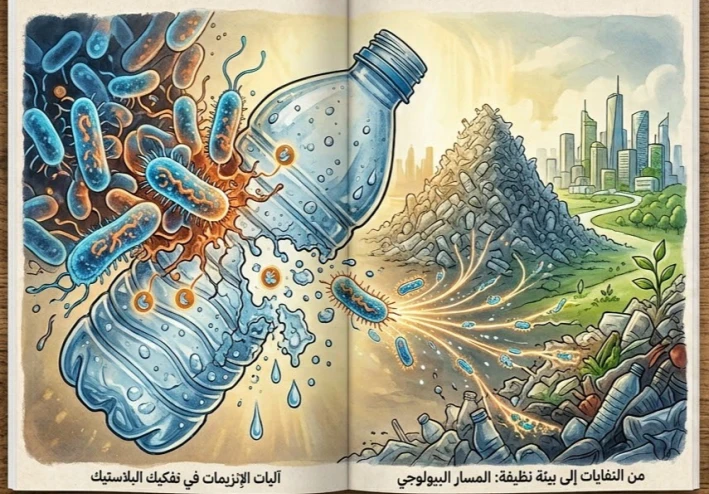
The biochemistry behind this discovery resembles a microscopic miracle. Plastic possesses long, immensely strong polymer chains that make it difficult for ordinary enzymes to penetrate. However, Ideonella sakaiensis uses an offensive strategy driven by two unique enzymes:
PETase enzyme: Secreted first to break the complex ester bonds within PET molecules, transforming them into an intermediate substance called MHET.
MHETase enzyme: Immediately steps in to chemically break down this intermediate substance into two simple, natural molecules: terephthalic acid and ethylene glycol.
The result? A plastic material that usually requires hundreds of years to decompose is transformed into natural organic matter that the bacteria feed on safely—without producing any toxic side effects.
A Revolutionary Advance: Speeding Up Breakdown Thousands of Times
![image about [اسرار العلم 2] البكتيريا الآكلة للبلاستيك: كيف يدمر اكتشاف مجهري جبال النفايات؟](https://s3media.amwcdn.com/content/689677/conversions/6ac6347ed4-attachments-webp.webp)
In 2018, while scientists from the University of Portsmouth—in collaboration with the U.S. National Renewable Energy Laboratory—were attempting to analyze the crystalline structure of the PETase enzyme using X-rays, something unexpected happened. Researchers accidentally modified the enzyme's structure, producing a "super-enzyme" that broke down plastic 20% faster than the natural version.
By 2020, research made a giant leap forward when technicians chemically linked PETase and MHETase to work together as a team, multiplying the speed of plastic breakdown sixfold! Then, in 2022, a team from the University of Texas announced the design of an AI-engineered variant called FAST-PETase, capable of breaking down plastic bottles within 24 to 48 hours while functioning effectively at low to moderate temperatures.
Have We Reached the Ultimate Solution to the Crisis?
Despite the great enthusiasm, turning this scientific discovery into an industrial application has faced several challenges. Natural enzymes are relatively slow and thermally unstable, and plastic dumped into oceans is mixed and made from various materials.
Nevertheless, this research has proven that bioengineering is capable of achieving closed-loop chemical recycling, where basic raw materials are recovered at 100% efficiency to produce high-quality new plastic without degrading its value or extracting new petroleum.
Ultimately, the discovery of these microscopic microbes remains new proof that nature always holds astonishing answers to the environmental problems created by humans!
Note to Readers: This article is the second part of my [Secrets of Science] series. In the next article, we will dive into space and astronomy: the📌 discovery of vast oceans of liquid water beneath the icy crusts of moons like Enceladus (orbiting Saturn) and Europa (orbiting Jupiter).
Report this article
Tell our review team about a problem with this content. Your details will not be shown to the author or other readers.
Your report could not be sent. Please try again later.
Sign in to report an article






Discussion
comments (0)
Share a perspective. Start a thoughtful conversation.
please login to be able to comment