

في هذا المقال
The Great African Total Solar Eclipse of August 2, 2027: A Complete Guide
Introduction
On August 2, 2027, the skies over Southwestern Europe, North Africa, and the Middle East will darken as one of the most spectacular celestial events of the century unfolds: a total solar eclipse. Millions of people will experience daylight turning into twilight as the Moon perfectly aligns with the Sun. Source: NASA Eclipse Predictions, GSFC
What Makes the 2027 Eclipse Historic
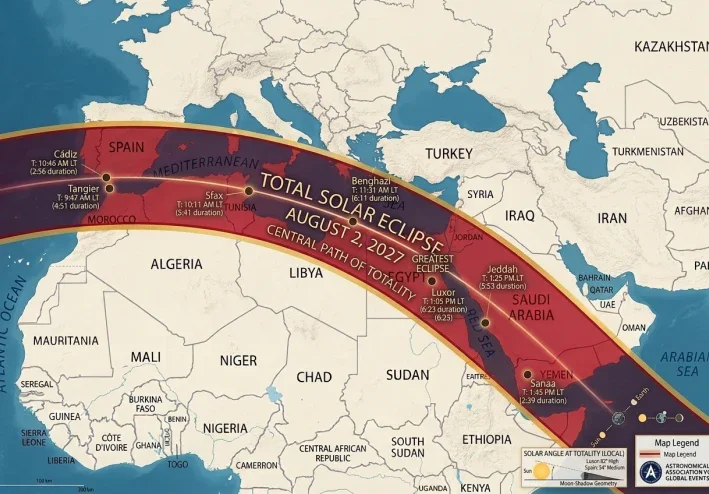
Solar eclipses occur roughly every 18 months somewhere on Earth, but most are brief or occur over oceans. The 2027 eclipse is exceptional because of its prolonged duration of totality. At its maximum point near Luxor, Egypt, the Sun will be completely covered for 6 minutes and 23 seconds. This makes it the second-longest eclipse of the 21st century and the longest accessible on land until the 22nd century. Source: NASA Eclipse Predictions, 2025
The European Space Agency (ESA) highlights that the path of totality crosses regions with historically clear skies, ensuring excellent visibility. Source: ESA Solar Studies, 2026
Global Coverage by Country
The path of totality is a narrow band about 258 km wide. Countries experiencing 100% coverage include Egypt, Algeria, Tunisia, Libya, Morocco, Spain (southern regions), Saudi Arabia, Yemen, Sudan, and Gibraltar. Other nations such as Italy, France, the United Kingdom, Greece, Turkey, and the United Arab Emirates will witness partial eclipses, with obscuration ranging from 30% to 95%. Sources: NASA Eclipse Maps, 2025; ESA Solar Studies, 2026
Key Prime Viewing Locations
Several cities stand out as prime destinations for eclipse chasers:
Luxor, Egypt – The epicenter of the event, offering 6m 23s of totality over ancient temples and monuments.
Oran, Algeria – A coastal city with ~5m 30s of totality and stunning Mediterranean views.
Tangier, Morocco – Positioned near the Strait of Gibraltar, with ~4m 50s of totality and clear coastal skies.
Sfax, Tunisia – Offering ~5m 40s of totality and exceptional atmospheric clarity.
Sources: NASA Eclipse Path Reports, 2025; ESA Travel Guidance, 2026
Essential Eye Safety Rules
Viewing the Sun without proper protection can cause permanent eye damage.
Certified Glasses: Use eclipse glasses compliant with ISO 12312-2:2015 international safety standard.
AAS Guidelines: The American Astronomical Society (AAS) confirms only ISO-certified filters are safe; ordinary sunglasses are not.
Indirect Viewing: Pinhole projectors or handheld solar viewers are safe alternatives.
Totality Exception: Naked-eye viewing is safe only during full totality; protection must resume immediately after.
This information is general and intended for educational purposes only, not medical advice. Sources: ISO 12312-2 Standard; AAS Safety Guidelines, 2025
Why You Should Plan Ahead
Because this eclipse coincides with peak travel season, hotels in Luxor, Oran, and Tangier are already filling up. ESA and NASA recommend securing accommodations and certified viewing gear well in advance. For residents of North Africa, this will be the event of the decade, attracting millions of astrotourists.
Travel agencies and astronomy groups emphasize that planning early ensures access to prime viewing spots and safe equipment. According to ESA Travel Advisory (2026), demand for flights and hotels along the path of totality is expected to exceed capacity months before the event. Sources: ESA Travel Advisory, 2026; NASA Eclipse Predictions, 2025
Conclusion
The Great African Total Solar Eclipse of August 2, 2027 is not just a celestial phenomenon—it is a cultural and scientific milestone. With its extraordinary duration, clear skies, and accessibility across historic regions, it promises to be one of the most memorable events of the century.
By following NASA, ESA, and AAS safety guidelines, and by preparing early, observers can enjoy this rare spectacle safely and meaningfully.
تابع جديد Antar Ain kouir
اختر إشعارات الموقع أو البريد أو الاثنين. الزائر يقدر يشترك ببريده دون تسجيل حساب.
الإبلاغ عن المقال
لو لاحظت مشكلة في المحتوى، أرسلها لفريق المراجعة. لن تظهر بياناتك لكاتب المقال أو للقراء.
تعذّر إرسال البلاغ الآن. حاول مرة أخرى لاحقًا.
سجّل الدخول لإرسال بلاغ







النقاش
التعليقات (0)
فكرة تضيفها، أو سؤال يفتح حوارًا.
الرجاء تسجيل الدخول لتتمكن من التعليق