

في هذا المقال
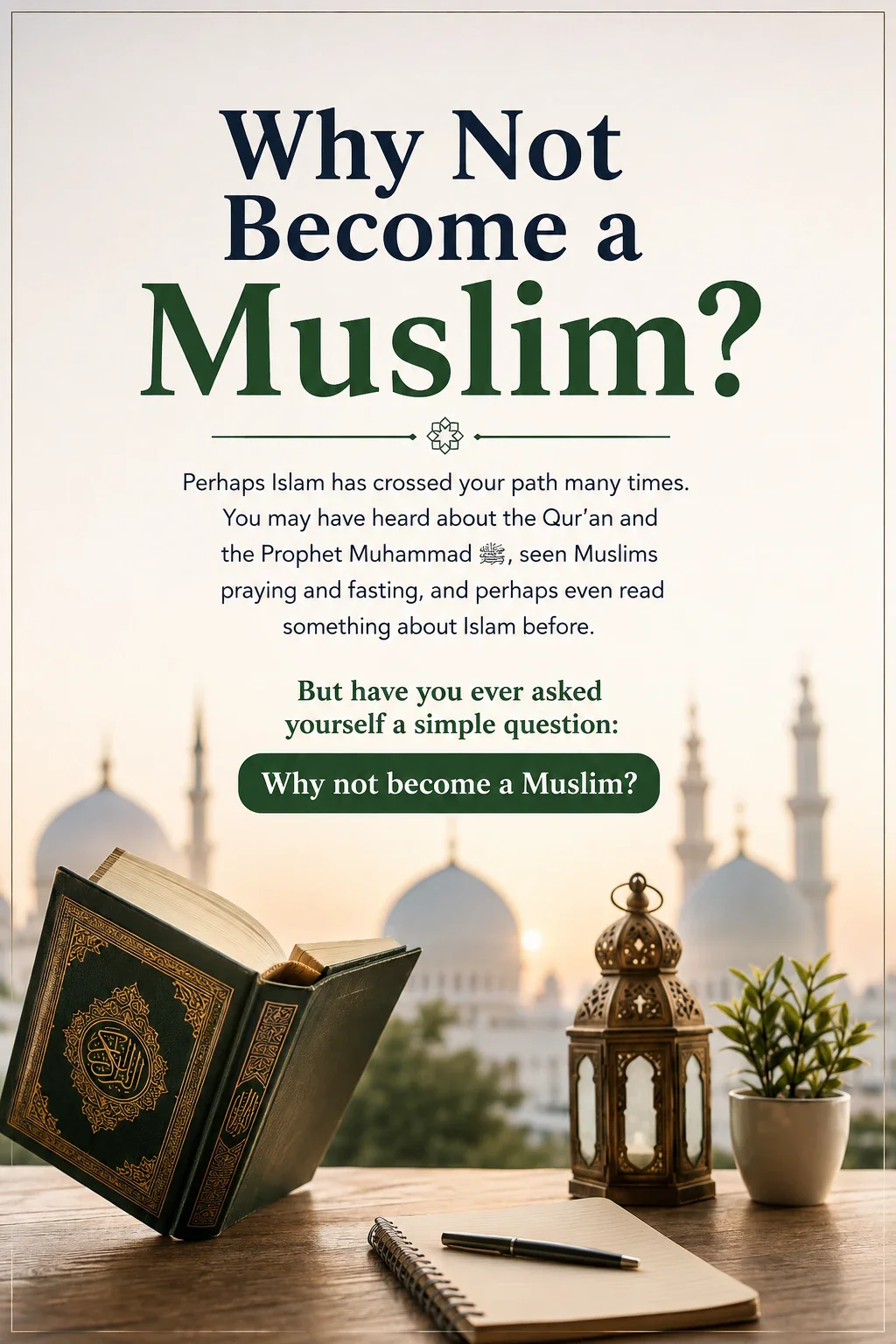
?Why Not Become a Muslim
Perhaps you have encountered Islam many times. You may have heard about the Holy Qur’an and the Prophet Muhammad, seen Muslims praying and fasting, and perhaps even read something about Islam before.
But have you ever asked yourself a simple question:
Why not become a Muslim?
By asking this question, I am not suggesting that you make a hasty decision, nor that you accept something simply because someone has asked you to.
Rather, I invite you to:
Look into Islam for yourself.
Explore it with an open mind.
And ask:
?What does Islam say about God
?What does it say about humanity, life, and death
?And is the Qur’an a book worthy of my thoughtful reflection
?What Does Islam Call People To
Islam calls people to believe in one God, without any partner or associate—the One who created humanity, the universe, and everything that exists. He is self-sufficient and in need of no one, while everything is dependent upon Him.
Islam does not call people to worship human beings, stones, or celestial bodies. Rather, it calls them to worship God alone.
- Know that a human being cannot be God, nor can God be a human being. You are either a human being or God; the two are fundamentally incompatible. Humanity is characterized by limitation and imperfection, while the Divine cannot be described by such deficiencies.
Likewise, the existence of multiple gods is impossible. If there were more than one god, there would necessarily be conflict and competition between them, each seeking to prevail over the other. Such conflict would ultimately lead to disorder and the destruction of their dominion, with one overcoming the other.
Yet when we look at the universe, we find it neither destroyed nor chaotic. Rather, it operates in harmony according to the laws established by the One God—Allah. He has no rival in His dominion, and no one can overcome Him. He is the One who prevails over all things.
Thus, Islam:
Rejects the idea that God is human. -
Rejects the concept of multiple gods. -
Rejects the idea that human beings exist without a purpose or role in life. -
- Rejects the idea that people will be left without reward for their faith and righteous deeds, or without punishment for disbelief and evil deeds.
The Human Being in Islam
Islam does not view human beings as creatures who were created without purpose.
Rather, the human being was created for a great purpose: to worship God alone.
In Islam, every person is responsible for their choices and actions.
According to the Islamic understanding, a human being:
1. Spends the early part of life as a young child, when they are not held accountable for their actions.
2. Once they reach maturity and their intellect, understanding, and ability to reason have developed, they become accountable for following what God has commanded and avoiding what He has forbidden.
This is the test upon which their ultimate destiny depends: either eternal life in Paradise or eternal life in Hell.
3. Then they return to God and are held accountable for what they did.
For it would not be reasonable for the one who was right to be treated the same as the one who was wrong, or for the hardworking person to be treated the same as the lazy one, or for the believer to be treated the same as the disbeliever.
This gives life meaning, purpose, and responsibility.
For example, imagine someone whose goal is to become a doctor. They are willing to study for many years and endure difficulties because they have a clear goal they want to achieve.
What gives them the motivation to persevere, study, work hard, and continue striving is the knowledge that they have a purpose—and that if they remain committed, they will eventually achieve their goal and distinguish themselves through their efforts.
?Is there another opportunity in Islam, or is there only one
This is what we will discuss, God willing, in the next article.
So, stay tuned.
تابع جديد Hamdy Badawy
اختر إشعارات الموقع أو البريد أو الاثنين. الزائر يقدر يشترك ببريده دون تسجيل حساب.
الإبلاغ عن المقال
لو لاحظت مشكلة في المحتوى، أرسلها لفريق المراجعة. لن تظهر بياناتك لكاتب المقال أو للقراء.
تعذّر إرسال البلاغ الآن. حاول مرة أخرى لاحقًا.
سجّل الدخول لإرسال بلاغ



النقاش
التعليقات (0)
فكرة تضيفها، أو سؤال يفتح حوارًا.
الرجاء تسجيل الدخول لتتمكن من التعليق