The Hippocampus and Hyperthymesia: The Science of Never Forgetting
The Hippocampus and Hyperthymesia: The Science of Never Forgetting
Subtitle:
Exploring Memory, Learning, and Extraordinary Human Recall
Abstract
This article explores the structure and functions of the hippocampus, one of the most important regions of the human brain responsible for memory and learning. It discusses the anatomy of the hippocampus, its role in converting short-term memories into long-term memories, and its connection to neurological disorders such as Alzheimer’s disease and epilepsy. The article also examines the rare condition known as hyperthymesia, in which individuals possess extraordinary autobiographical memory. Through these topics, the article highlights the hippocampus's role 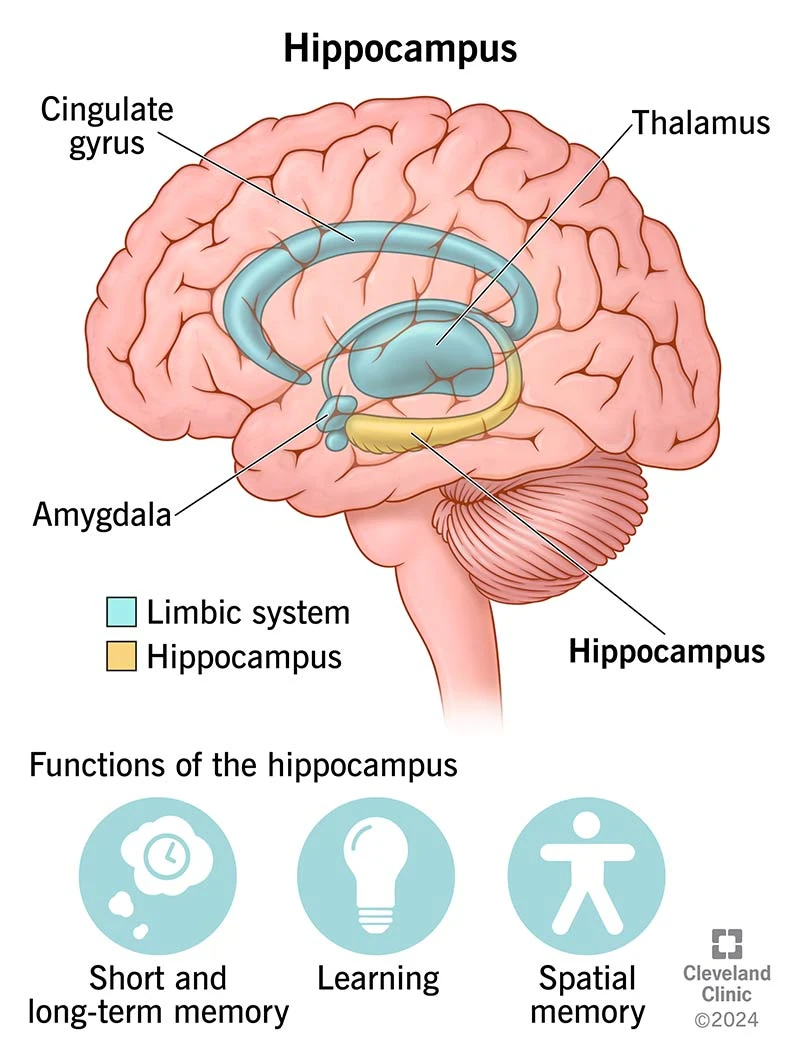 in shaping human memory and cognition.
Introduction
Every memory you have from your childhood to what you studied yesterday depends on a small but powerful structure deep inside your brain: the hippocampus. Although many people have never heard of it, damage to the hippocampus can completely change a person’s ability to learn, remember, and even navigate familiar places. This article will explore the anatomy and functions of the hippocampus, its role in memory formation and learning, its connection to neurological diseases such as Alzheimer’s disease, and extraordinary memory conditions like hyperthymesia.
Anatomy and Functions of the Hippocampus
Firstly, the anatomy and function of the hippocampus. The word Hippocampus is of Greek origin and means "seahorse" because of its shape. It is located inside the medial temporal lobe in approximately the hemisphere of the brain. In humans, there is a right hippocampus and a left hippocampus.
The hippocampus consists of several main parts, including the dentate gyrus. It is responsible for receiving new information and helps distinguish between similar memories.
Cornu Ammonis (CA regions) are divided into:
- CA1
- CA2
- CA3
- CA4
CA1 is important for memory formation and retrieval, and it is one of the first areas affected in Alzheimer’s disease. CA3 helps connect and reconstruct memories.
The hippocampus is strongly connected to:
- the amygdala
- the cerebral cortex
- the thalamus
- other parts of the limbic system
These connections allow it to organize memories and link them to emotions and experiences.
The branches of the posterior cerebral artery primarily supply the hippocampus. Reduced blood flow can damage hippocampal tissue and impair memory.
Its cellular structure includes pyramidal neurons, granule cells, and neural circuits involved in memory processing. It is also one of the few brain regions capable of limited neurogenesis, meaning it can form new neurons even in adulthood.
Its unique layered structure and neural connections allow the hippocampus to convert short-term memories into long-term memories, support spatial navigation, and facilitate learning and memory recall.
Diseases Related to the Hippocampus
Because the hippocampus plays a major role in memory and learning, damage to it can lead to serious neurological disorders.
One of the most well-known diseases associated with the hippocampus is Alzheimer’s disease. Alzheimer’s disease is a progressive neurological disorder that affects millions of people worldwide. Scientists discovered that one of the earliest brain regions damaged in Alzheimer’s disease is the hippocampus.
As hippocampal cells begin to degenerate, patients often experience difficulty forming new memories and remembering recent events. This explains why many Alzheimer’s patients may remember events from many years ago but forget conversations or experiences that happened recently.
Another condition related to the hippocampus is epilepsy, especially temporal lobe epilepsy. In some patients, abnormal electrical activity occurs near the hippocampus, leading to seizures and memory problems.
Chronic stress and depression may also affect the hippocampus. Studies have shown that prolonged exposure to stress hormones such as cortisol can reduce hippocampal volume and negatively affect memory and concentration.
Scientists have also found that lifestyle factors can influence hippocampal health. Regular exercise, healthy sleep patterns, and continuous learning may improve hippocampal function and even support neurogenesis.
Hyperthymesia: The Science of Never Forgetting
One of the most fascinating conditions related to memory is Hyperthymesia, also known as Highly Superior Autobiographical Memory (HSAM).
People with this rare condition can remember an extraordinary amount of personal experiences and life events in exceptional detail. For example, they may remember what they wore, what they ate, or what happened on a specific day many years ago.
Scientists believe that hyperthymesia is associated with unusual activity and connectivity between the hippocampus and other memory-related brain regions, particularly the amygdala.
Since the amygdala is heavily involved in emotional processing, researchers think that strong emotional associations may help preserve memories more vividly and for longer periods of time.
Although hyperthymesia may sound like a superpower, it can also create psychological challenges. Some individuals with the condition report difficulty forgetting painful memories or emotionally stressful experiences.
Unlike ordinary memory, which naturally fades over time, autobiographical memories in hyperthymesia remain highly detailed and persistent. This shows that forgetting may actually play an important role in maintaining emotional balance and mental health.
Researchers continue to study hyperthymesia because it provides valuable insight into how the human brain stores and retrieves information.
Conclusion
In conclusion, the hippocampus is one of the most important and fascinating structures in the human brain. Despite its relatively small size, it plays a critical role in memory formation, learning, spatial navigation, and the organization of human experiences.
The hippocampus is also closely connected to several neurological disorders, particularly Alzheimer’s disease, in which memory gradually deteriorates as hippocampal tissue becomes damaged.
At the same time, extraordinary conditions such as hyperthymesia demonstrate the incredible potential of the human brain and reveal how memory can function in unusual ways.
As neuroscience continues to advance, scientists may discover even more about how the hippocampus shapes human identity, learning, and consciousness. Ultimately, studying the hippocampus not only helps us understand memory disorders but also helps us better understand what makes us human.