
في هذا المقال
10 FASCINATING FACTS ABOUT YERBA MATE AND ITS RITUALS BETWEEN ARGENTINA AND SYRIA
In the world of beverages, it is rare for two peoples from different continents to share the same daily habit. Yerba mate, however, is a striking exception. It is an essential part of everyday life in Argentina, and at the same time holds a special place among Syrians—despite the vast geographical and cultural distance between them.
For many Syrians, mate was not a drink discovered in cafés or shops, but a tradition passed down through family gatherings and long conversations. In Argentina, mate is consumed in streets, universities, and workplaces, often becoming a lifelong companion from an early age. In Syria, it has evolved into a symbol of togetherness and extended social moments, particularly in certain regions, where it has become part of local identity.
This unusual similarity raises an intriguing question: how did a South American drink make its way to the Middle East, and how did it acquire different rituals yet similar meanings in two distant cultures? Here are ten fascinating facts about yerba mate and the traditions that turned it into a shared way of life between Argentinians and Syrians.
1️⃣ HOW YERBA MATE TRAVELED FROM SOUTH AMERICA TO SYRIA
Yerba mate did not spread in Syria through direct trade or a passing trend. Instead, it arrived through human migration in the late 19th and early 20th centuries. During that period, thousands of Syrians—particularly from mountainous regions—emigrated to South American countries such as Argentina in search of work and better living conditions. There, they encountered mate as a central element of daily life and social interaction.
When some of these migrants returned to Syria, or maintained close contact with their families back home, they brought mate with them, along with its tools and rituals. For many, it was not merely a new flavor, but a taste connected to memories and experiences lived far from home.
Gradually, mate spread among relatives and friends, not just as a beverage, but as a habit tied to sitting together, talking, and sharing time. Despite the difference in environment and culture, mate found its place in Syrian society, becoming a rare example of a tradition that crossed continents and settled into a completely different context.
2️⃣ YERBA MATE AS A SOCIAL AND PERSONAL DRINK
Yerba mate has a rare ability to combine two opposites: it is deeply social, yet perfectly suited for solitude. In group settings, mate often becomes the focal point of the gathering, with the cup circulating among those present and conversations flowing freely and without formality. This simple ritual fosters a sense of connection and breaks down barriers, making mate a social act before it is a daily habit.
At the same time, mate retains a strong personal dimension. Many people drink it alone in the early morning or during work and study, seeing it as a tool for focus and mental clarity.
In Argentina, this dual nature is especially visible, as people carry mate with them through streets, public transport, and universities, drinking it casually throughout the day. In Syria, mate has leaned more toward a home-centered experience, prepared with care and enjoyed during quiet indoor moments. This balance between the collective and the individual is what allowed mate to take root in both cultures without losing its essence.
3️⃣ ONE CUP OR MANY: THE RITUAL OF SHARING
At its core, yerba mate is built on the idea of sharing, though the way this idea is expressed differs across cultures. In Argentina, the tradition of the single shared cup is fundamental. Everyone drinks from the same vessel using the same metal straw, which is passed from hand to hand in an unspoken order. For Argentinians, this practice is not unusual but rather a symbol of trust and belonging, where personal boundaries dissolve within the group.
In Syria, sharing takes on a different and more varied form. In some specific regions, such as Sweida, the tradition of a single shared cup remains strong.
However, in many other areas—like the coastal regions, Homs, and Damascus—each person typically has their own cup and straw. Nevertheless, the shared kettle remains the unifying element around which the gathering forms. This variation does not diminish the spirit of participation; instead, it reflects a balance between social closeness and personal space, giving Syrian mate rituals a distinctive character.
4️⃣ THE BENEFITS OF YERBA MATE
Yerba mate is not consumed for its taste alone, but for its effects that extend beyond the moment itself. Many rely on it in the morning to enhance focus and alertness. While it contains caffeine, its effect is often described as more balanced than coffee, providing gradual energy without the jittery sensation some people experience.
Beyond its stimulating qualities, mate is known for containing antioxidants and minerals, which has contributed to its reputation as a drink that supports digestion and comfort after heavy meals.
In Argentina, it is commonly consumed plain to preserve its natural flavor and properties. In Syria, however, people often add aromatic herbs such as chamomile blends or lemon balm, giving mate a calming dimension that balances energy with relaxation. In this sense, mate’s benefits extend beyond the physical, influencing mood and the social atmosphere surrounding its consumption.
5️⃣ YERBA MATE AS AN ALTERNATIVE TO COFFEE
For many people, yerba mate has become a gentle alternative to coffee and its fast-paced rhythm. While a cup of coffee is usually consumed quickly and its effects fade just as fast, mate accompanies its drinkers for hours, offering steady alertness without urgency. The kettle remains nearby, inviting patience rather than a rush for an instant caffeine boost.
This alternative takes different forms across cultures. In Argentina, mate often completely replaces coffee and is consumed early in the morning, at work, and even while commuting.
In Syria, mate is more commonly enjoyed in the afternoon or evening, serving as a calm substitute for coffee during long social gatherings without causing sleeplessness or anxiety. In this way, mate offers the alertness of coffee with added warmth and a slower pace, appealing to those who value clarity of mind over speed.
6️⃣ DAILY RITUALS SURROUNDING YERBA MATE
Daily rituals are what transform mate from a simple drink into a stable part of everyday rhythm. The preparation itself carries meaning: choosing the cup, filling it carefully, adjusting the water temperature, and taking the first sip that marks the beginning of the session. These small details create a sense of grounding, as if mate enforces a pause amid daily chaos.
In Argentina, these rituals are tied to movement and continuity, with mate accompanying people throughout the day without a fixed place or time.
In Syria, rituals are more closely associated with the home and slower moments, where mate is prepared in the morning or evening and becomes a routine that brings family or friends together. Between sips, mate is not merely consumed—it becomes a space where the day is reorganized, stories are shared, and moments are given their due value.
7️⃣ YERBA MATE AS A SYMBOL OF IDENTITY
Over time, yerba mate has gone beyond being a beverage to become a clear marker of identity. Carrying a mate cup or kettle is no longer a trivial detail, but an unspoken signal of belonging to a shared way of life. In Argentina, mate stands as a national symbol embedded in everyday routines, reflecting simplicity and communal spirit.
In Syria, mate has acquired a different but equally deep meaning. It has become a cultural and social symbol associated with specific communities and regions, fostering a sense of shared identity among those who drink it.
A mate session is not just a break in the day, but a space where collective memory is revived, traditions are preserved, and stories are passed from one generation to the next. Mate, in this sense, is an identity that is experienced rather than explained.
8️⃣ MATE TOOLS: MORE THAN ACCESSORIES
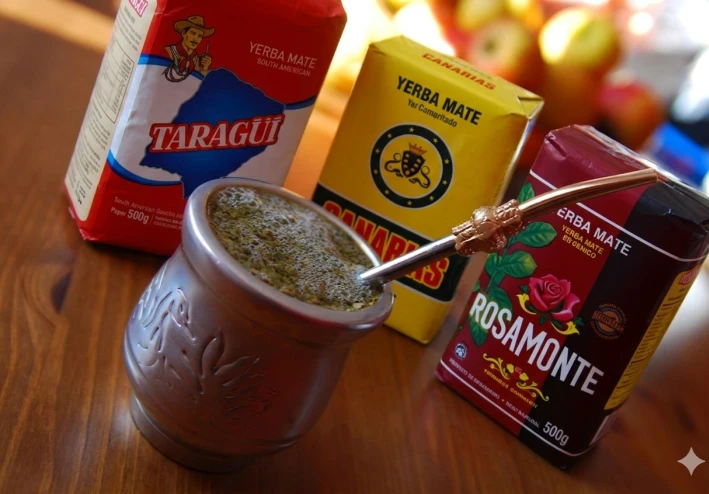
The mate experience is incomplete without its distinctive tools, which have evolved from simple utensils into symbols with cultural significance. The cup—often called the gourd—varies in shape, size, and material across cultures, from natural wood in Argentina to glass or ceramic in Syrian homes. Choosing a cup is often a personal matter, reflecting individual taste and connection to the ritual.
The metal straw is perhaps the most iconic element, treated with particular respect, especially in cultures that share a single cup. Its design is functional rather than random, with a filter that prevents leaves from passing through and a shape that ensures comfort.
Completing this small world is the kettle, carefully maintained to keep the water at the ideal temperature. Together, these tools turn mate into a complete experience where form is as important as flavor.
9️⃣ WITH OR WITHOUT SUGAR: A MATTER OF TASTE
Few topics spark debate among mate drinkers like the addition of sugar. For many, mate should be consumed bitter, with sugar seen as something that masks its true character. This view is especially common in Argentina, where bitterness is considered an essential part of the experience and a sign of respect for tradition.
In contrast, many drinkers prefer adding sugar or aromatic herbs to soften the taste, particularly during long sessions or when sharing the drink with family and friends. Here, sugar or sweetness is not viewed as a distortion, but as a personal choice reflecting individual preference and adaptation.
This preference is a purely personal choice that varies from one person to another regardless of region. Between these two approaches, the debate remains unresolved, as mate itself seems to allow each person to redefine it in their own way.
🔟 YERBA MATE: AN IDENTITY YOU DRINK
Ultimately, yerba mate cannot be reduced to a flavor or a daily habit. It is not simply leaves soaked in hot water, but a complete experience infused with memory, belonging, and a way of life. From Argentina to Syria, mate crossed borders and continents while preserving its core essence: creating a shared moment, whether among a group gathered around a kettle or an individual finding calm in a single cup.
What truly makes mate unique is its ability to adapt without losing meaning. Rituals changed, tools evolved, and methods of drinking varied, yet the essence remained intact.
It is a tradition passed down more than it is taught, understood through practice rather than explanation. In this way, yerba mate became an identity that is consumed, reflecting how people relate to time and to one another—and proving that some drinks are not merely consumed, but lived
<img src="https://amwaly.com/images/logo.png" width="100" />
تابع جديد Gorge Elias
اختر إشعارات الموقع أو البريد أو الاثنين. الزائر يقدر يشترك ببريده دون تسجيل حساب.
الإبلاغ عن المقال
لو لاحظت مشكلة في المحتوى، أرسلها لفريق المراجعة. لن تظهر بياناتك لكاتب المقال أو للقراء.
تعذّر إرسال البلاغ الآن. حاول مرة أخرى لاحقًا.
سجّل الدخول لإرسال بلاغ









النقاش
التعليقات (0)
فكرة تضيفها، أو سؤال يفتح حوارًا.
الرجاء تسجيل الدخول لتتمكن من التعليق