

في هذا المقال
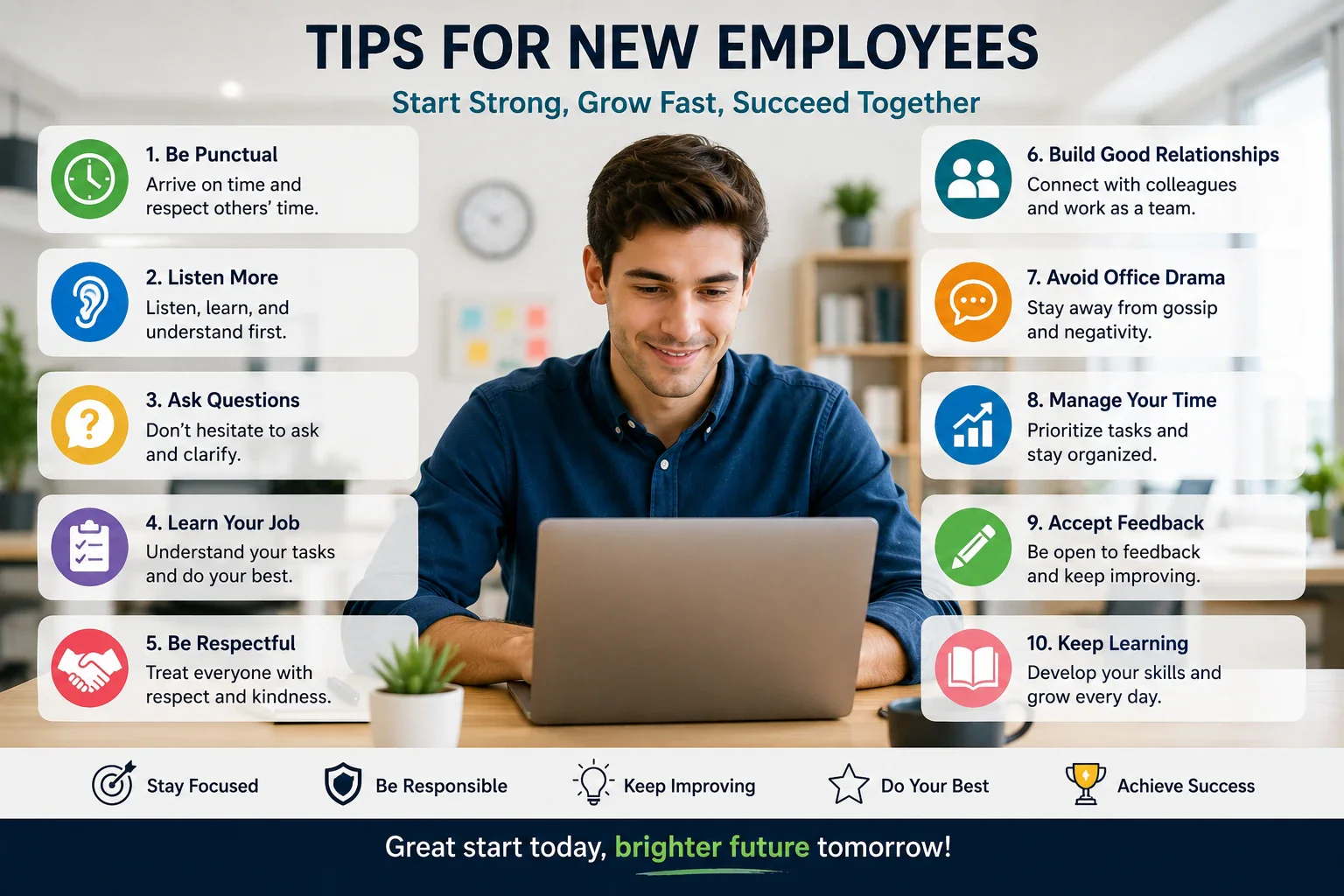 : Your Guide to Succeeding and Adapting to a New Job
Introduction
Have you recently started a new job and feel confused about how to deal with your new workplace? Don’t worry. Starting a new job can be challenging, especially when you have to work with new people, learn unfamiliar systems, and adapt to a completely different work environment.
Knowing the right tips for new employees can help you adapt faster, avoid common mistakes, and build positive relationships with your colleagues and manager. Your first few months at a new job are also an important opportunity to prove yourself, gain valuable experience, and develop skills that can support your future career.
In this article, we will share some of the most important tips for people starting a new job, from understanding your responsibilities and workplace culture to dealing with colleagues, managing your time, and improving your performance.
1. Take Time to Understand the Work Environment
When you start a new job, don’t try to change everything from day one. Give yourself enough time to understand how the workplace operates, learn its rules and procedures, and identify your responsibilities.
Observe how employees communicate with one another, understand the management structure, and learn who is responsible for each task.
Remember that understanding your work environment from the beginning will help you make better decisions and avoid many uncomfortable situations.
2. Always Be on Time
Being punctual is one of the simplest things you can do to make a positive impression from your first day.
Try to arrive at work on time. If possible, arriving a few minutes early can also help you prepare for the day without feeling rushed.
Being punctual sends a clear message that you are responsible and respect other people's time.
Do not wait until your manager repeatedly points out your lateness. Make punctuality a habit from the beginning.
3. Listen More Than You Speak at First
One of the most important tips for new employees is to listen and learn before making judgments or offering suggestions.
You may see a particular way of doing things and believe there is a better approach. However, there may be reasons behind the current system that you do not know yet.
Therefore, ask questions and understand the situation first. Once you have a clear picture of how things work, you can offer your ideas and suggestions.
4. Don’t Be Afraid to Ask Questions
It is completely normal not to know everything when starting a new job.
If you do not understand a particular task, ask the person responsible for it in a clear and respectful way. Asking the right question at the right time is much better than making a mistake because you were afraid to ask.
However, try to write down the information you receive so that you do not have to ask the same question repeatedly.
5. Learn Your Responsibilities Well
Do not settle for knowing only the minimum required from you. Try to fully understand your responsibilities and learn why you are performing each task and how it affects the overall workflow.
The more you understand your role, the more independent and confident you will become.
With time and practice, tasks that seemed difficult at first will become much easier.
6. Treat All Your Colleagues With Respect
Do not let differences in job titles or positions affect the way you treat people.
Treat your manager, coworkers, new employees, and everyone else in the workplace with respect. Positive professional relationships can help you create a comfortable and productive work environment.
Respect does not mean agreeing with everyone. It means being able to disagree in a professional and respectful manner.
7. Stay Away From Gossip and Workplace Drama
One common mistake some new employees make is getting involved too quickly in personal conflicts and workplace problems.
If you hear a coworker speaking negatively about a manager or another employee, it is better not to immediately join the conversation, especially if you do not know the full story.
Avoid gossip and unnecessary conflicts whenever possible. Focus on your responsibilities and build a professional reputation based on your work.
8. Don’t Try Too Hard to Prove Yourself
It is natural to want to prove yourself when starting a new job. However, you should not try to do everything at once.
Do not make promises you cannot keep, and do not accept an unrealistic number of tasks just to show that you can handle everything.
The best way to prove yourself is through quality work, reliability, and responsibility, rather than excessive talking or trying to impress everyone.
9. Accept Feedback and Constructive Criticism
You may receive feedback from your manager or colleagues about your performance, especially during your first few weeks.
Do not automatically consider every piece of feedback a personal attack. Try to understand what you can improve and use the feedback to develop your performance.
A person who accepts constructive criticism and learns from mistakes usually develops faster than someone who refuses to admit their weaknesses.
10. Learn From Your Mistakes
No employee starts a new job knowing everything, so making some mistakes is completely normal.
The important thing is to avoid repeating the same mistake without understanding why it happened.
When you make a mistake, take responsibility when appropriate, look for a way to correct it, and learn from the experience.
A mistake can become a valuable lesson that helps you grow professionally.
11. Organize Your Time and Tasks
When starting a new job, you may have many tasks to complete. That is why learning time management at work is extremely important.
Write down your tasks and organize them according to their importance, priority, and deadlines.
Focus on the most important tasks first, and do not allow small tasks to consume all your time while more important responsibilities remain unfinished.
12. Keep Notes
One of the best habits you can develop when starting a new job is keeping a notebook or digital file for important information.
Write down task instructions, procedures, system names, important details, and anything you may need to remember later.
This simple habit can help you learn faster and become more independent in your work.
13. Understand the Company Culture
Every workplace has its own culture. Communication styles, working hours, meetings, and even dress codes can vary from one company to another.
Try to understand the workplace culture and respect it as long as it does not conflict with your rights or basic professional standards.
Understanding company culture can help you integrate into the team more easily.
14. Build Good Professional Relationships
Focusing on your work does not mean completely ignoring the people around you.
Get to know your colleagues, be friendly, participate in appropriate conversations, and help others when you can without allowing it to interfere with your main responsibilities.
Good professional relationships can help you learn new skills, understand the workplace better, and discover future career opportunities.
15. Don’t Share Too Much About Your Personal Life
When starting a new job, it is generally better to maintain a reasonable level of privacy.
Of course, you can get to know your colleagues and have friendly conversations, but you do not need to share every detail about your personal life or private problems.
Try to maintain healthy boundaries between your personal life and your professional life.
16. Know Your Rights and Responsibilities
It is important to understand your employment contract, working hours, vacation policies, responsibilities, and the basic rules that govern your workplace.
Knowing your rights and responsibilities makes you more aware of what is expected from you and helps you handle potential problems in a calm and professional way.
17. Ask for Help When You Need It
Being independent is a valuable quality, but that does not mean you have to solve every problem on your own.
If you face a problem that goes beyond your experience or authority, ask the appropriate person for help.
A good employee is not someone who knows everything. A good employee knows when help is needed and how to ask for it professionally.
18. Don’t Compare Yourself With Experienced Employees
You may see an experienced coworker completing tasks very quickly and feel that you are falling behind.
Remember that this person may have spent years in the company and developed a great deal of experience, while you are still at the beginning of your journey.
Compare your current performance with your previous performance and focus on continuous improvement rather than comparing yourself with others.
19. Keep Developing Your Skills
Getting a job is not the end of your learning journey. It is the beginning of a new stage of professional development.
Try to improve your skills, learn the tools and software related to your field, read regularly, and benefit from the experience of your colleagues.
Every new skill you develop can help you qualify for better opportunities in the future.
20. Make Your First Few Months a Learning Period
Do not make getting a promotion or proving that you are the best employee your main goal during your first few months.
Instead, focus on learning, understanding your role, and building a strong professional reputation.
As time passes, you will gain more experience and confidence, understand your strengths and weaknesses, and become better prepared to decide on your next career step.
Common Mistakes New Employees Should Avoid
There are several mistakes that can negatively affect the way a new employee is perceived in the workplace. These include:
Being repeatedly late for work.
Criticizing workplace procedures before understanding them.
Getting involved in coworkers’ personal conflicts.
Sharing confidential workplace information.
Ignoring your manager’s instructions.
Making promises that you cannot keep.
Spending excessive amounts of work time on personal matters.
Rejecting feedback or constructive criticism.
Repeating the same mistakes without learning from them.
Trying to build personal relationships with everyone too quickly.
Constantly speaking negatively about the workplace.
Neglecting professional development.
How Can You Make a Good Impression at Your New Job?
First impressions are important, but they are not everything. What matters most is maintaining a positive professional reputation over time.
Be punctual, complete your tasks properly, communicate respectfully, remain open to learning, help your colleagues when possible, and stay calm when facing difficult situations.
By following these simple principles, you can gradually build trust with your colleagues and manager.
Conclusion
Starting a new job requires time before you feel completely comfortable and understand the workplace and your responsibilities. Therefore, do not put unnecessary pressure on yourself to know everything from day one.
Focus on learning, respect your colleagues, be punctual, organize your time, accept feedback, stay away from unnecessary conflicts and gossip, and continue developing your skills.
Remember that success at work depends not only on technical skills but also on commitment, communication, adaptability, and the ability to keep learning.
Start your new job with confidence and patience, and make every day an opportunity to gain new experience and build a better professional future.
تابع جديد Latest
اختر إشعارات الموقع أو البريد أو الاثنين. الزائر يقدر يشترك ببريده دون تسجيل حساب.
الإبلاغ عن المقال
لو لاحظت مشكلة في المحتوى، أرسلها لفريق المراجعة. لن تظهر بياناتك لكاتب المقال أو للقراء.
تعذّر إرسال البلاغ الآن. حاول مرة أخرى لاحقًا.
سجّل الدخول لإرسال بلاغ







النقاش
التعليقات (0)
فكرة تضيفها، أو سؤال يفتح حوارًا.
الرجاء تسجيل الدخول لتتمكن من التعليق