


In this article
How to Save $500 a Month: A Realistic Step-by-Step Approach :
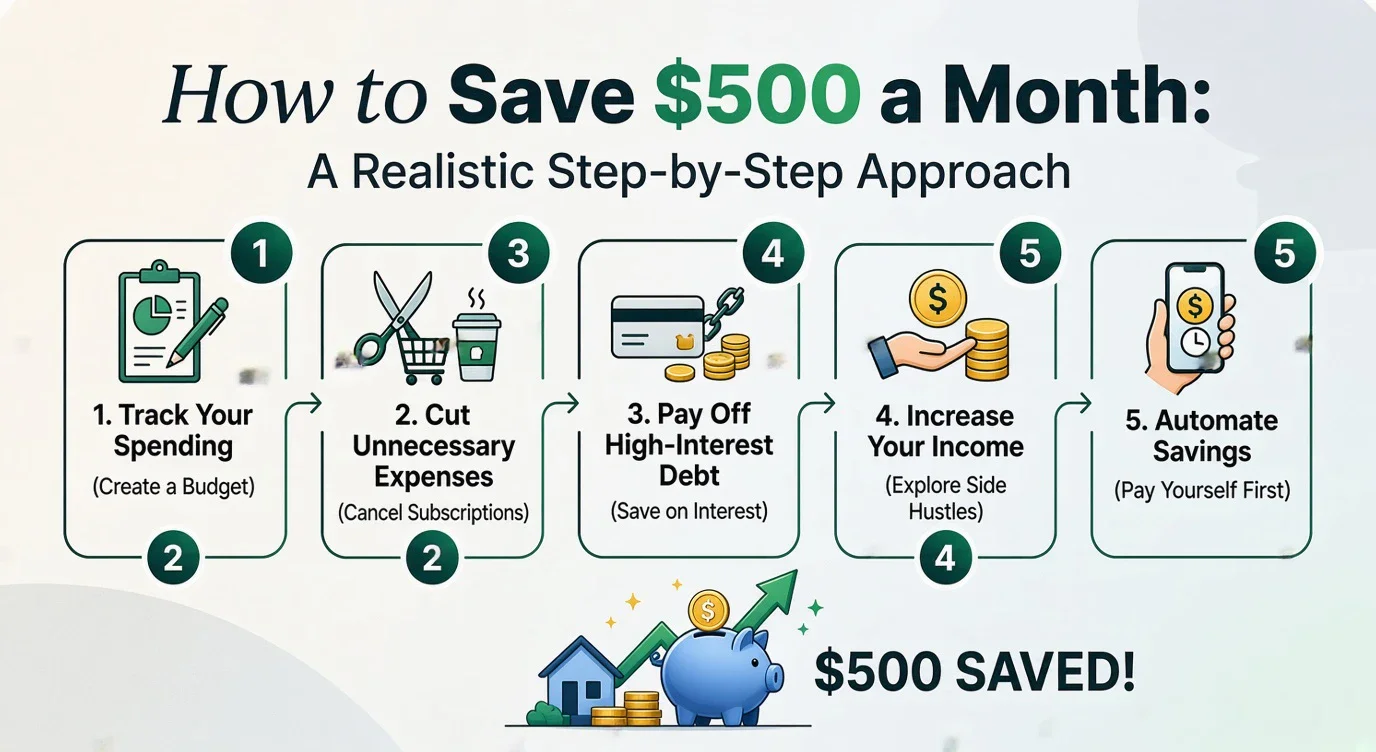
Saving an extra $500 every month might sound difficult, especially when groceries, bills, transport and everyday expenses keep adding up.
But you don't necessarily need to make a huge lifestyle change to save more money. In many cases, small changes across several areas of your budget can add up to a significant amount by the end of the month.
Here are some realistic ways you can work towards saving $500 a month.
1. Take a Closer Look at Your Grocery Spending
For many households, groceries are one of the easiest places to find savings.
Before going shopping, make a simple list and try to stick to it. Planning a few meals in advance can also help reduce impulse purchases and food waste.
You can also compare prices between supermarkets, choose home-brand products when the quality is similar, and check whether buying certain items in larger quantities actually saves money.
Even saving $20–$30 a week on groceries could make a noticeable difference over a month.
Potential monthly saving: $80–$120
2. Reduce Takeaway Coffee and Food
You don't have to stop buying coffee or eating out completely.
Instead, look at how often you're doing it.
For example, if you normally buy a takeaway coffee every weekday, replacing just a few of those coffees with coffee made at home could save a reasonable amount over the month.
The same applies to takeaway meals. Cooking an extra portion at dinner and taking the leftovers to work can be much cheaper than buying lunch.
Potential monthly saving: $50–$100
3. Review Your Subscriptions
Take five minutes to check your bank account and list every recurring subscription you are paying for.
You might find streaming services, apps, memberships or other subscriptions that you rarely use.
You don't necessarily need to cancel everything. Keeping the services you genuinely use while removing the ones you don't can free up money every month.
Even a few unnecessary subscriptions can add up over a year.
Potential monthly saving: $20–$60
4. Look at Your Energy Usage
Electricity bills can take a significant chunk out of a household budget.
Simple habits can help reduce unnecessary energy use. Turn off lights and appliances when they're not needed, avoid running appliances unnecessarily and pay attention to heating and cooling usage.
It can also be worth checking your current electricity plan from time to time to make sure it still suits your household.
The goal isn't to make your home uncomfortable. It's simply to avoid paying for energy you don't really need.
Potential monthly saving: $20–$50
5. Cut Down on Unnecessary Car Costs
For people who drive regularly, transport can be another area where small changes add up.
Combining errands into one trip, carpooling when practical, keeping your tyres properly inflated and avoiding unnecessary driving can help reduce fuel and maintenance costs.
If public transport is a realistic option for some journeys, using it occasionally instead of driving may also reduce your monthly expenses.
Potential monthly saving: $30–$70
6. Try a "No-Spend" Weekend
You don't have to stop spending money for an entire month.
Try starting with one weekend.
Instead of going shopping, ordering takeaway or paying for expensive entertainment, look for free or low-cost activities.
Australia has plenty of options, including beaches, parks, walking trails, public spaces and outdoor activities.
A single low-spending weekend every month can help you become more aware of where your money normally goes.
Potential monthly saving: $30–$60
7. Wait Before Making Non-Essential Purchases
One simple rule can make a surprisingly big difference: don't buy something immediately just because you want it.
For larger non-essential purchases, give yourself 24 or 48 hours before deciding.
You may discover that you don't actually need the item.
For things you still want after waiting, compare prices and look for discounts before buying.
Avoiding just a couple of unnecessary purchases each month could save more than you expect.
Potential monthly saving: $30–$80
8. Put the Savings Somewhere You Won't Spend Them
Saving money becomes much easier when the money is separated from your everyday spending.
Consider setting up a separate savings account and transferring money into it regularly.
You can start with a small amount and increase it as you become more comfortable with your budget.
The important thing is to make saving automatic rather than relying on whatever money happens to be left at the end of the month.
So, Can You Really Save $500 a Month?
For some People, saving $500 a month may be realistic. For others, it may take longer or require bigger changes.
The important thing is that you don't need to save $500 from one category.
For example, your monthly savings might look something like this:
- Groceries: $100
- Takeaway and coffee: $75
- Subscriptions: $30
- Energy: $30
- Transport: $50
- Entertainment and shopping: $75
- Other small changes: $40
That's already $400.
Finding another $100 through a combination of smaller changes could bring the total closer to the $500 goal.
The Bottom Line
Saving $500 a month doesn't have to mean completely changing your lifestyle.
Instead, look at your spending as a collection of small decisions.
Saving $10 here, $20 there and $50 somewhere else might not feel significant on its own. But over several weeks, those small amounts can add up.
Start by looking at your biggest everyday expenses, choose two or three areas to improve, and track your progress for a month.
You might be surprised by how much money you can save without giving up everything you enjoy.
Keep up with Mohamed
Choose site notifications, email, or both. Guests can subscribe by email without an account.
Report this article
Tell our review team about a problem with this content. Your details will not be shown to the author or other readers.
Your report could not be sent. Please try again later.
Sign in to report an article








Discussion
comments (0)
Share a perspective. Start a thoughtful conversation.
please login to be able to comment