The Chemistry of Group 18: Atomic Stability, Synthetic Breakthroughs, and Industrial Utility
Beyond Inertness: The Structural Elegance and Applications of Noble Gases
Group 18 of the periodic table houses a unique family of elements known as the noble gases: helium (He), neon (Ne), argon (Ar), krypton (Kr), xenon (Xe), and the radioactive radon (Rn). For decades following their discovery in the late 19th century by Lord Rayleigh and William Ramsay, these elements were labeled "inert gases" due to their apparent refusal to react with other elements. Today, modern chemistry understands that while their reactivity is exceptionally low, it is not completely nonexistent. This article explores the atomic foundations of their stability, their shared physical characteristics, the breakthrough discoveries of noble gas compounds, and their critical roles in modern technology.
The Quantum Basis of Chemical Stability
To understand why noble gases behave so passively, one must look at their electron configurations. Each element in Group 18 possesses a completely filled valence shell. Except for helium, which satisfies its outer shell with just two electrons (1s²), all other noble gases have eight valence electrons, following the characteristic ns² np⁶ configuration.
This outer-shell configuration represents a state of minimum electronic energy. Because the valence orbitals are entirely full, these atoms experience no energetic drive to gain, lose, or share electrons with other elements. Consequently, their ionization energies—the energy required to remove an electron—are among the highest in the periodic table, while their electron affinities are close to zero. This creates an immense thermodynamic barrier to standard chemical bonding.
Shared Physical Traits
Under standard conditions of temperature and pressure, noble gases exhibit remarkably uniform physical properties. They are entirely colorless, odorless, and tasteless monatomic gases. Because they exist as isolated, individual atoms rather than diatomic molecules (unlike oxygen or nitrogen), their interatomic forces are limited to weak London dispersion forces.
This weak attraction explains why they possess extremely low melting and boiling points relative to their atomic masses. Helium, for instance, has the lowest boiling point of any known substance at -268.9°C and cannot be solidified under atmospheric pressure alone. As you move down the group from helium to radon, the atomic radii increase. This larger electron cloud leads to stronger temporary dipoles, resulting in a predictable, steady rise in boiling points and densities down the column.
Challenging the Inertia Paradigm
The long-standing scientific dogma that noble gases were entirely incapable of forming chemical chemical bonds was shattered in 1962 by chemist Neil Bartlett. He successfully synthesized xenon hexafluoroplatinate (XePtF6), proving that under specific, highly reactive conditions, the heavier noble gases could participate in chemical reactions.
Because the valence electrons in larger noble gases like xenon and krypton are located further from the nucleus, they are heavily shielded by inner electron shells. This lower effective nuclear charge reduces their ionization energy, allowing highly electronegative elements like fluorine and oxygen to coax them into bonding. Today, a variety of xenon and krypton compounds—such as XeF2, XeF4, and KrF2—are well-documented in laboratory settings, though they remain highly reactive and require careful handling.
Industrial and Technological Deployments
Despite their chemical aloofness—or often precisely because of it—noble gases are indispensable across various modern industries:
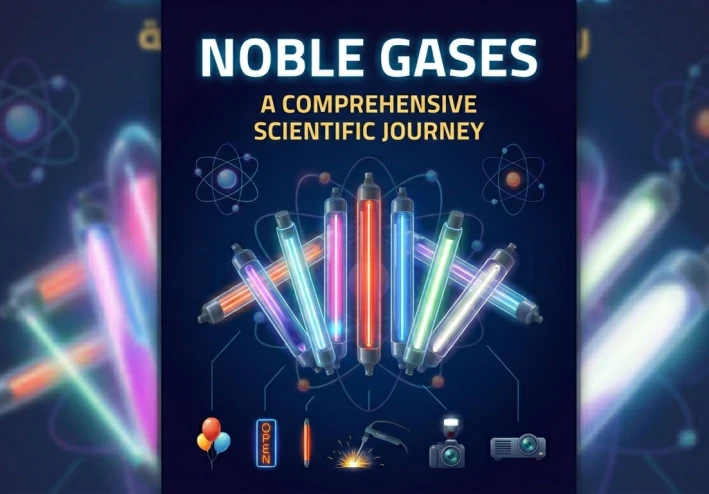
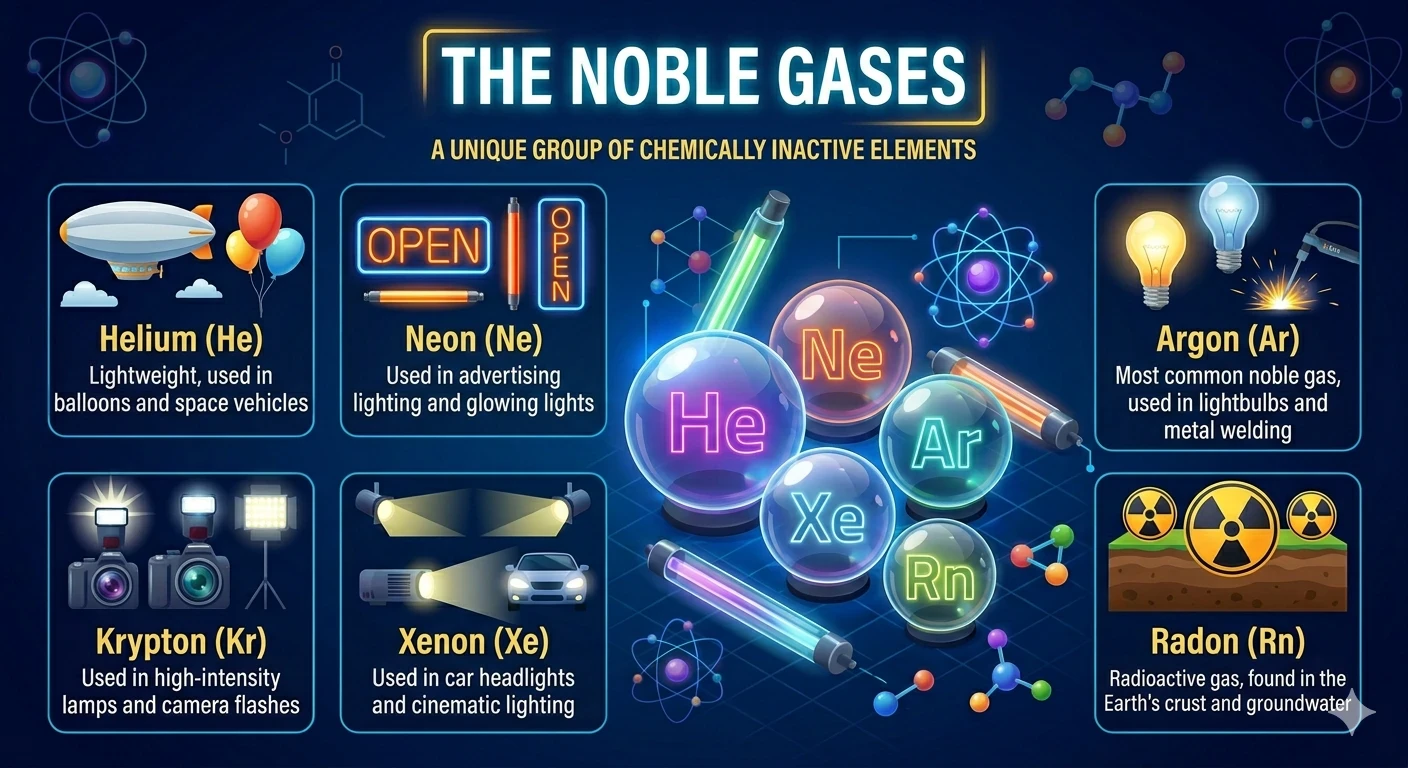
- Helium: Essential in cryogenics, particularly for cooling the superconducting magnets in MRI machines. Its low density and non-flammable nature also make it the global standard for high-altitude research balloons.
- Argon: The most abundant noble gas on Earth, argon provides an affordable, inert atmosphere for high-temperature industrial processes. It is widely used in arc welding and titanium manufacturing to prevent hot metals from oxidizing.
- Neon, Krypton, and Xenon: Heavily utilized in specialized lighting and optics. Xenon, in particular, is critical for high-intensity discharge (HID) lamps, commercial cinema projectors, and specialized ion-propulsion engines for deep-space exploration.
- Radon: Despite its radiological hazards, radon finds niche applications in geology for tracking groundwater movement and predicting earthquakes, alongside historic uses in targeted cancer radiotherapy.
Conclusion
The noble gases serve as an excellent bridge between theoretical quantum mechanics and practical industrial utility. From the predictable stability of their electron shells to their unexpected reactivity under extreme constraints, these elements continue to be fundamental to both chemical theory and technological progress. Far from being simple, inactive bystanders on the periodic table, they remain vital components of modern scientific advancement.