

في هذا المقال
Rewire Your Brain
(in 12 Ways)
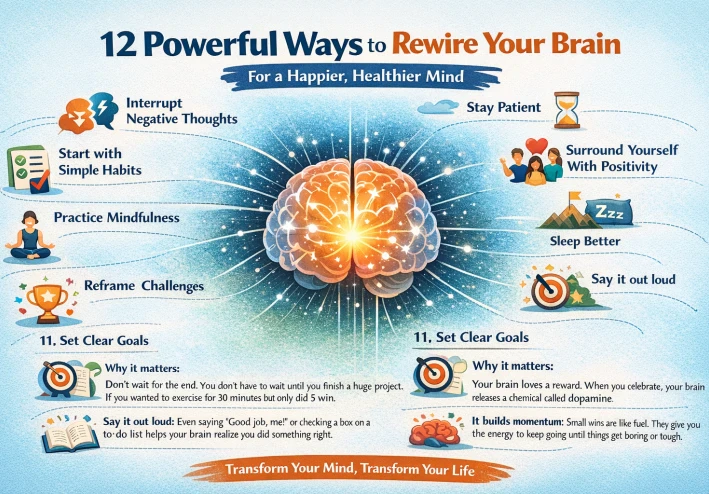
Interrupt Negative Thoughts
Catch and replace harmful thoughts. Each shift weakens old patterns
Begin with Simple Habits
Start small to avoid overwhelm. Consistency builds lasting change
Mindfulness
Boost emotional control and focus. Mindfulness strengthens key brain areas
Sleep Better
Sleep builds and reinforces neural pathways. It's essential for memory and growth
Reframe Challenges
See obstacles as growth opportunities. This mindset builds resilience
Move your Body
Exercise releases BDNF to repair the brain. Movement fuels neural growth
Celebrate Small Wins
Why it matters: Your brain loves a reward. When you celebrate, your brain releases a chemical called dopamine. This makes you feel good and want to do it again
More details
Don't wait for the end: You don't have to wait until you finish a huge project. If you wanted to exercise for 30 minutes but only did 5, that is still a win!
Say it out loud: Even saying "Good job, me!" or checking a box on a to-do list helps your brain realize you did something right
It builds momentum: Small wins are like fuel. They give you the energy to keep going until you reach the big goals
Recognize the Impact of Stress
Why it matters: When you are stressed all the time, your brain stays in "survival mode." This makes it hard to learn new things or think clearly
More details
Stress "freezes" the brain: Chronic stress is like a traffic jam in your head. It stops new ideas from moving
Micro-breaks help: You don’t need an hour of meditation. Just taking three deep breaths when you feel frustrated can tell your brain, “It's okay, we are safe
Build a "calm habit": Doing something relaxing every day—like drinking tea, walking, or listening to music—actually repairs the parts of your brain that stress damaged
Learn Something New
Why it matters: Learning is like a workout for your brain. It keeps your mind young and "stretchy" (this is called neuroplasticity)
More details
It can be anything: You don’t have to go to university. You can learn a new cooking recipe, a few words in a new language, or even a new game
Challenge is good: If it feels a little bit hard at first, that means your brain is growing. It’s making new "wires" to connect information
Curiosity is key: Staying curious keeps your brain active. When you stop learning, your brain gets "lazy." When you learn, you stay sharp and fast
Set Clear Goals
Why it matters: Your brain is like a GPS. If you don't give it a specific address, it just circles around. Clarity helps you stop wasting energy on things that don't matter
More details
Be Specific: Instead of saying "I want to be successful," say "I want to read 10 pages today." The brain loves a target it can actually see
Write it Down: When you write a goal, it moves from just a "thought" to a "mission." This helps your brain focus even when you are busy
The "Why" is the engine: Knowing why you want something gives you the "fuel" to keep going when things get boring or tough
Surround Yourself With Positivity
Why it matters: Your brain has something called "mirror neurons." This means you naturally start to act and think like the people you spend the most time with
More details
Check your "Circle": If your friends always complain, your brain learns to look for problems. If your friends are motivated, your brain learns to look for opportunities
Digital Environment counts: It’s not just people. The videos you watch and the accounts you follow on social media "program" your mind. Choose things that make you feel capable, not insecure
Clean your space: A messy or dark room can make you feel heavy. A clean, bright space helps your brain feel "light" and ready to work
Stay Patient
Why it matters: Rewiring your brain is like growing a tree. You can't yell at a seed to grow faster. It happens slowly, underground, before you see the results
More details
The "Dip": There is always a time when you feel like nothing is changing. This is when most people quit. But this is actually when the brain is doing the hardest "wiring" work
Consistency over Intensity: Doing 5 minutes of a good habit every day is much better than doing 3 hours once a week. Your brain learns through repetition
Forgive yourself: If you have a bad day and go back to old habits, don't worry. Just start again the next morning. One bad day doesn't break the new "wires" you've built
تابع جديد Yasmina
اختر إشعارات الموقع أو البريد أو الاثنين. الزائر يقدر يشترك ببريده دون تسجيل حساب.
الإبلاغ عن المقال
لو لاحظت مشكلة في المحتوى، أرسلها لفريق المراجعة. لن تظهر بياناتك لكاتب المقال أو للقراء.
تعذّر إرسال البلاغ الآن. حاول مرة أخرى لاحقًا.
سجّل الدخول لإرسال بلاغ






النقاش
التعليقات (0)
فكرة تضيفها، أو سؤال يفتح حوارًا.
الرجاء تسجيل الدخول لتتمكن من التعليق