Why Silence and Empathy Are Your Greatest Superpowers in a Noisy World
Why Silence and Empathy Are Your Greatest Superpowers in a Noisy World
In a world that never stops talking, we often grow up believing that the loudest voice in the room is the one that holds the most ultimate authority and power. From endless social media debates and aggressive comment sections to fast-paced workplace environments, modern society relentlessly conditions us to react instantly, respond to every passing opinion, and aggressively defend our personal point of view. We have been subtly trained to treat almost every human interaction as a competitive debate to be won at all costs, rather than a valuable opportunity to connect, listen, or learn from another perspective. However, both ancient classical philosophy and modern psychological science reveal a profound, counter-intuitive truth about human nature: real strength does not come from emotional noise, verbal dominance, or constant chatter. True personal authority, inner emotional stability, and high intellectual maturity actually lie in the quiet, deliberate practice of intentional silence and deep emotional empathy.
When you closely observe the most influential leaders, thinkers, and historical figures throughout human history, you quickly notice that they rarely scrambled to fill every uncomfortable moment with meaningless words. Instead, they understood the immense strategic, emotional, and psychological value of total self-restraint. In our modern digital age—a time characterized by overwhelming information overload, chronic mental distraction, and widespread emotional burnout—learning how to consciously harness the dual superpowers of silence and empathy is no longer just a philosophical exercise for academics. It has become an essential, practical survival skill for maintaining mental well-being, protecting your focus, and building deeply authentic human relationships.
1. The Hidden Power of Intentional Silence
The ancient Taoist philosopher Lao Tzu famously stated, “Silence is a source of great strength.”
In modern fast-paced culture, silence is frequently misunderstood and unfairly labeled. It is often mischaracterized as a sign of weakness, personal indifference, social awkwardness, or a complete lack of self-confidence. But in reality, choosing to remain silent in moments of intense conflict, provocation, or social chaos is the absolute highest form of emotional discipline and mental control.
When you intentionally refrain from reacting immediately to personal attacks, hasty criticisms, or external noise, you create a vital psychological buffer between the external stimulus and your internal reaction. This brief, calculated pause breaks the automatic cycle of emotional impulse, effectively allowing your logical mind to evaluate the situation clearly before making a conscious, dignified choice.
Major Benefits of Daily Silence:
Enhanced Cognitive Clarity: Pausing before responding prevents impulsive statements, dramatically reduces emotional regret, and significantly improves the quality of your decision-making processes.
Reduced Stress and Anxiety: Stepping back from constant noise lowers cortisol levels in your body, calms your central nervous system, and preserves your finite cognitive energy.
Mastery Over Your Environment: Remaining composed and quiet when others expect an aggressive reaction gives you quiet dominance, dignity, and control over any chaotic room.
Deeper Self-Awareness: Silence forces you to look inward rather than constantly reacting to external distractions, helping you align your daily actions with your core personal values.

2. Empathy: The Ultimate Display of Intellectual Wisdom
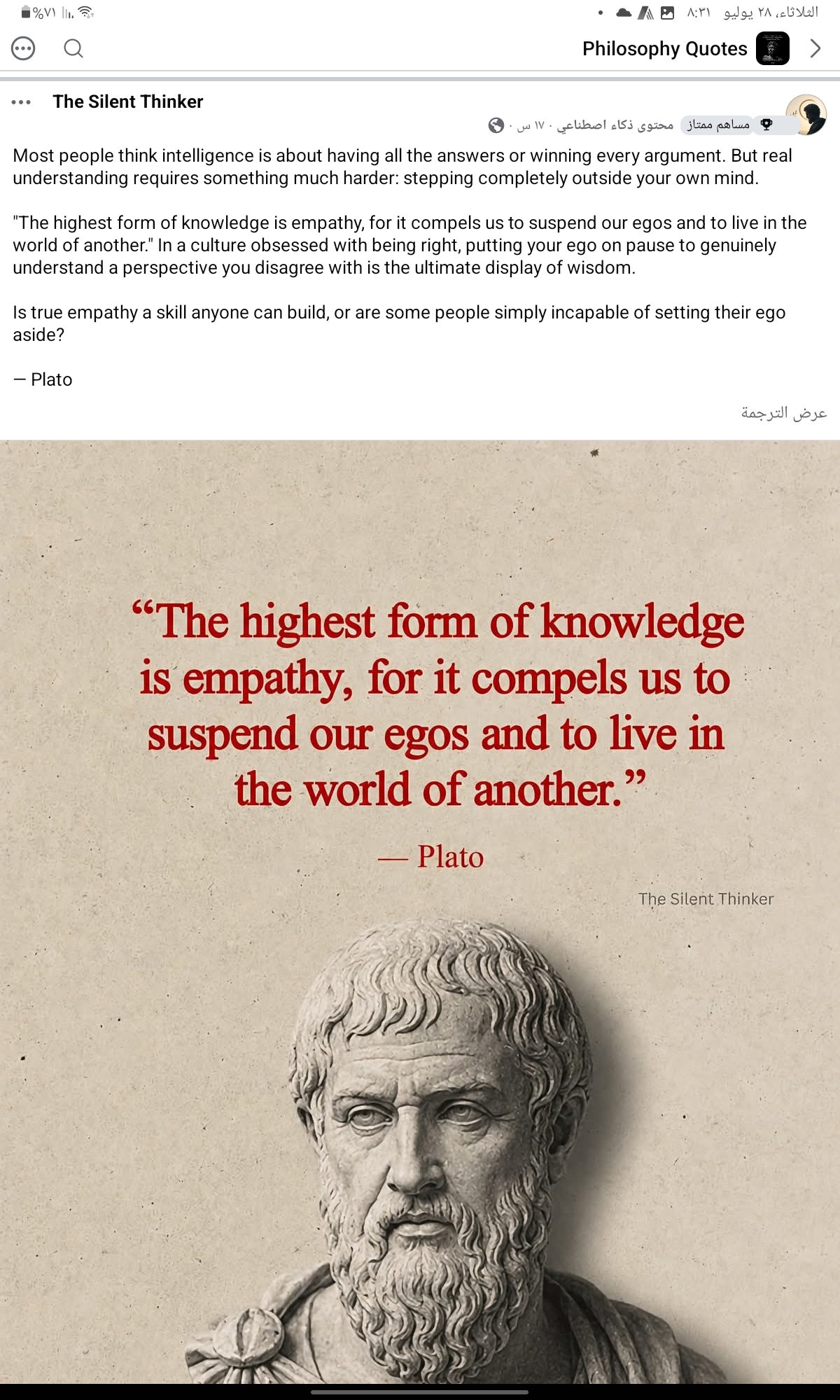
The Greek philosopher Plato once wrote, “The highest form of knowledge is empathy, for it compels us to suspend our egos and to live in the world of another.”
Most interpersonal conflicts do not occur because people lack raw intelligence or analytical capability; they happen because human beings struggle with emotional perspective. We live in an individualistic culture obsessed with "winning" arguments rather than genuinely understanding complex human experiences. True wisdom requires the courage to step completely outside your own ego and view a troubling situation through the lens of someone else's personal history, hidden pain, and unique perspective.
When you practice authentic empathy, you intentionally lower your defense mechanisms. You come to realize that understanding a conflicting perspective does not mean agreeing with it or surrendering your personal principles. It simply demonstrates that you are emotionally mature enough to acknowledge another person's subjective reality without feeling defensive or threatened by it.
3. Practical Daily Steps to Cultivate Silence and Empathy
Integrating these ancient, time-tested philosophical principles into your modern daily life is far more accessible than it sounds. You do not need to retreat to a isolated mountain monastery or completely abandon technology; you simply need to change how you interact with daily stimulation:
Implement the 5-Second Pause Rule: Whenever you encounter unexpected bad news, personal criticism, or a heated argument, force yourself to take five slow, deliberate breaths before uttering a single word. This instantly resets your nervous system.
Listen to Understand, Not to Reply: In your daily conversations, stop mentally formulating your rebuttal while the other person is still speaking. Give them your complete, unhurried, and uninterrupted presence.
Select Your Battles Wisely: Recognize that you are never obligated to attend every conflict or debate you are invited to. Protecting your psychological peace is infinitely more valuable than achieving a temporary victory in an irrelevant debate.
Practice Intentional Unplugging: Dedicate at least 15 to 30 minutes every morning or evening to complete digital silence. Turn off notifications, put away your phone, and allow your mind to rest in stillness without consuming external content.

Conclusion: Reclaiming Control Over Your Mind
At its core, mastering your life always begins with mastering your internal mental reactions to the world around you. You cannot control the chaotic nature of the external environment, the unpredictable opinions of others, or the endless noise of modern media. However, you possess absolute, non-negotiable ownership over how you choose to internalize and respond to these external events.
By consciously stepping back from mindless noise, cultivating deliberate moments of quiet reflection, and choosing emotional empathy over ego-driven conflict, you build an unshakeable inner foundation. You transition from being a passive victim of your immediate emotional impulses to becoming the true master of your internal state. In doing so, you effectively safeguard your long-term mental health, cultivate deep and meaningful human connections, and navigate the complex realities of modern life with lasting confidence, emotional clarity, and profound inner peace. True power is never about having the last word—it is about having total control over your own mind.