
In this article
🧬 How Can DNA Store Information?
Introduction
Inside every cell in the human body, there is a remarkable molecule that carries a huge amount of information: DNA, or deoxyribonucleic acid. DNA can be compared to a detailed instruction manual that tells cells how to build proteins and organize many biological processes.
But how can such a tiny molecule carry all this information? The secret lies in the order of its chemical components. Cells use a system based on four chemical letters through which genetic information can be written and stored.
What Is DNA?
DNA is a long molecule made up of small units called nucleotides. Each nucleotide contains a sugar, a phosphate group, and a nitrogenous base.
There are four main nitrogenous bases in DNA:
- Adenine (A)
- Thymine (T)
- Cytosine (C)
- Guanine (G)
These bases are arranged along the DNA molecule in different sequences, and this sequence is what carries genetic information.
How Do the Bases Become Information?
The process can be compared to a written language. A language uses a group of letters to form words and sentences, while DNA uses four types of bases to form a genetic code.
For example, we might have a sequence of bases such as:
A – T – G – C – C – A – T
This sequence represents a small part of the information stored in DNA. When the cell reads this information in an organized way, it can use it to produce molecules that are essential for its functions.
Therefore, the information is not contained in the individual bases alone, but in their order and sequence.
How Does the Cell Read the Information in DNA?
Cells do not use DNA randomly. Instead, they have complex systems for reading the information stored within it.
When a cell needs to produce a specific protein, information from an appropriate section of DNA is copied into a molecule called RNA. The cell then uses this RNA as instructions for producing the protein.
The process of transferring information from DNA to RNA is called transcription, while the process of converting the information in RNA into a chain of amino acids is called translation.
In this way, information moves from the code stored in DNA to proteins that perform different functions inside cells.
Why Can DNA Store a Large Amount of Information?
One of the most remarkable properties of DNA is its ability to store a huge amount of information in an extremely small space. This is possible because the molecule is very small and can contain enormous numbers of bases arranged in long sequences.
DNA can also preserve information for relatively long periods, while cells have mechanisms that help repair many types of damage that may occur to the genetic material.
For these reasons, scientists are also interested in the possibility of using DNA as a future method for storing digital data.
DNA as a Digital Data Storage System
The concept of storing information in DNA is not limited to biological information. Scientists have begun studying the possibility of using DNA to store digital data such as text, images, and files.
The basic idea is to convert digital data, which is usually represented using the binary system of 0s and 1s, into sequences made from the bases found in DNA.
Because DNA can store a large amount of information in an extremely small space, it is considered a promising technology for long-term data storage. However, using it on a large scale still faces challenges related to cost and the speed of writing and reading data.
Is DNA Storage Perfect?
Despite its great potential, DNA is not a perfect information-storage system. Errors can occur while genetic material is being copied, and DNA molecules can also become damaged by different factors.
Living organisms have developed mechanisms that can repair many of these errors. In artificial DNA storage systems, scientists can also use techniques designed to detect and correct errors.
This demonstrates how complex the biological system is for preserving genetic information and passing it from one generation to another.
Conclusion
DNA is one of the most fascinating information-storage systems found in nature. Using only four types of chemical bases, it can store complex genetic instructions inside an extremely small molecule.
The key idea is the order and sequence of the bases, much like words and sentences depend on the arrangement of letters.
As biology and technology continue to advance, scientists are no longer studying DNA only to understand life. They are also exploring its remarkable ability to store information and its potential to inspire new data-storage technologies for the future.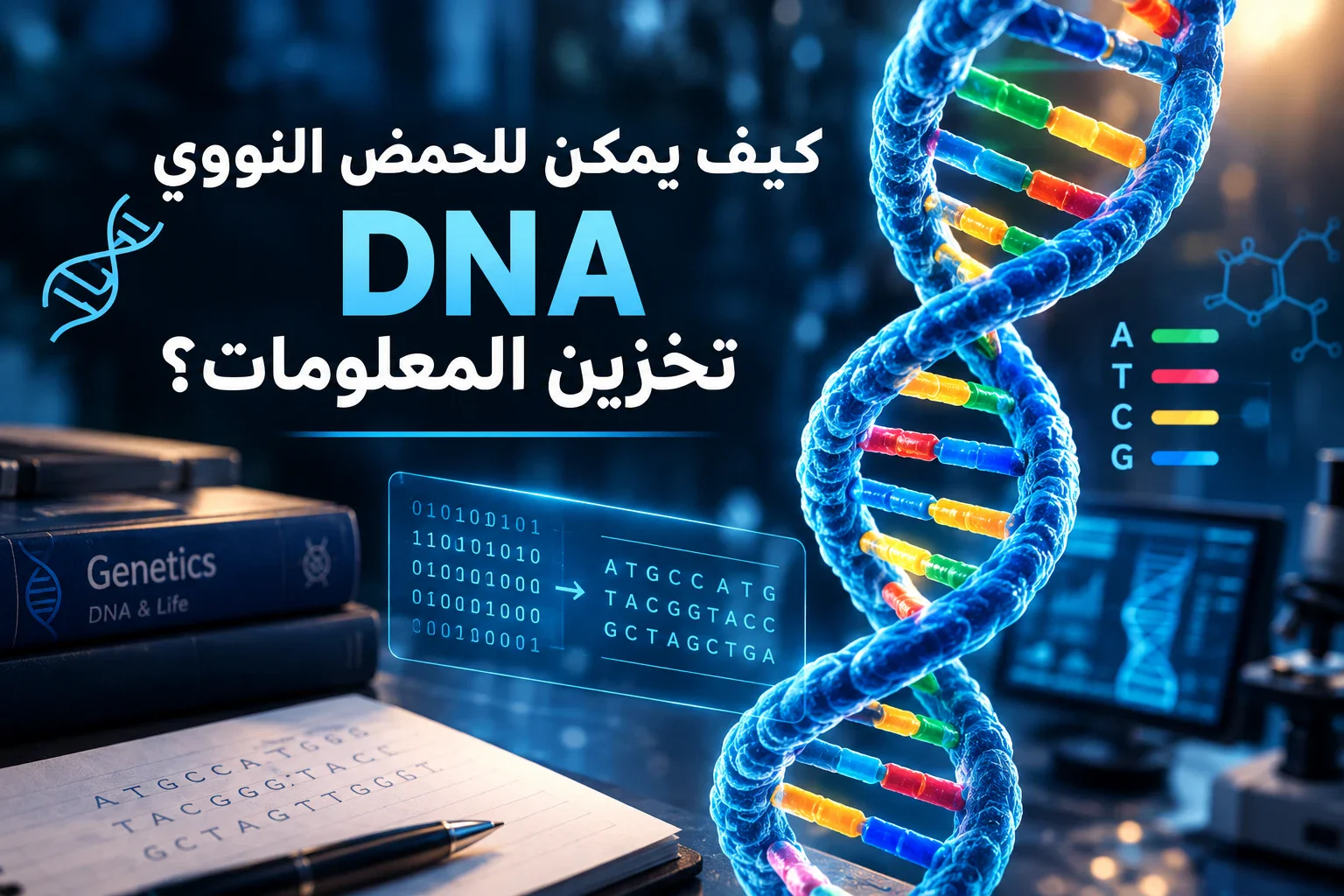
Keep up with Ahmed
Choose site notifications, email, or both. Guests can subscribe by email without an account.
Report this article
Tell our review team about a problem with this content. Your details will not be shown to the author or other readers.
Your report could not be sent. Please try again later.
Sign in to report an article





Discussion
comments (0)
Share a perspective. Start a thoughtful conversation.
please login to be able to comment