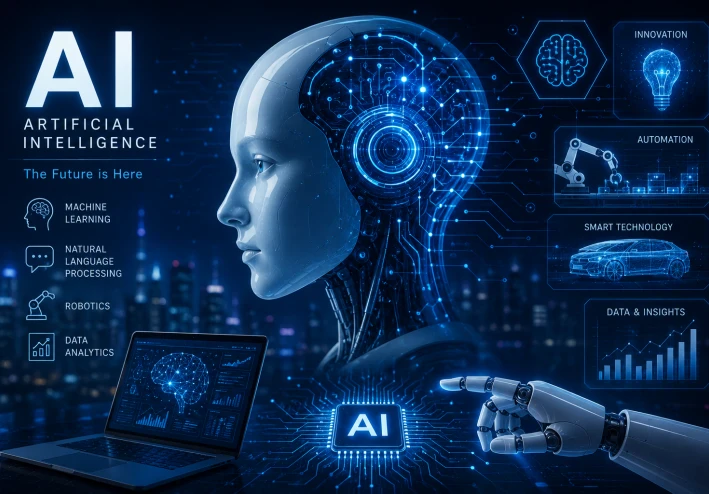
Artificial Intelligence: Shaping the Future of Humanity Introduction
Artificial Intelligence: Shaping the Future of Humanity Introduction
Artificial Intelligence (AI) has become one of the most revolutionary technologies of the 21st century. Once considered a concept limited to science fiction, AI is now transforming the way people live, work, communicate, and solve problems. From voice assistants and smart healthcare systems to autonomous vehicles and personalized online services, AI is changing nearly every aspect of modern life. Its ability to analyze enormous amounts of data, recognize patterns, and make intelligent decisions has made it an essential tool for innovation and progress. As AI continues to evolve, it is not only improving existing technologies but also creating entirely new possibilities that were unimaginable just a few decades ago.
What Is Artificial Intelligence?
Artificial Intelligence is a specialized field of computer science that focuses on developing machines capable of performing tasks that normally require human intelligence. These tasks include learning from experience, understanding language, recognizing images, solving complex problems, and making decisions. Unlike traditional computer programs that simply follow pre-written instructions, AI systems can continuously improve their performance by analyzing data and adapting to new situations. Technologies such as Machine Learning, Deep Learning, and Natural Language Processing enable AI to become increasingly accurate, efficient, and capable of handling real-world challenges.
Applications of Artificial Intelligence
AI has become an indispensable part of many industries. In healthcare, it assists doctors in diagnosing diseases earlier, interpreting medical images with remarkable accuracy, and discovering new treatments. In education, AI creates personalized learning experiences by adapting lessons to each student's strengths and weaknesses. Businesses rely on AI-powered chatbots to provide instant customer support, while advanced analytics help companies understand customer behavior and improve decision-making. Financial institutions use AI to detect fraud, manage risks, and enhance cybersecurity. Transportation systems benefit from AI through intelligent traffic management and the development of self-driving vehicles. Entertainment platforms like Netflix, Spotify, and YouTube use AI algorithms to recommend content based on individual preferences, making user experiences more enjoyable and personalized.
Advantages of Artificial Intelligence
The advantages of AI extend far beyond automation. It significantly increases productivity by performing repetitive tasks faster and with greater accuracy than humans. AI minimizes human errors, supports data-driven decision-making, and operates around the clock without fatigue. It accelerates scientific research by processing vast amounts of information in a short time, helping researchers make groundbreaking discoveries. AI also improves accessibility for people with disabilities through speech recognition, language translation, and assistive technologies. Furthermore, it contributes to environmental protection by optimizing energy consumption, monitoring climate changes, and supporting sustainable development initiatives.
Challenges and Ethical Concerns
Despite its enormous potential, AI presents several important challenges. The automation of routine jobs may reduce employment opportunities in certain industries, making continuous education and skill development essential for workers. Privacy concerns arise because AI systems often rely on collecting and analyzing personal data. Additionally, AI algorithms may unintentionally reflect bias if they are trained using unfair or incomplete datasets. Ethical questions regarding transparency, accountability, and responsible decision-making continue to be major topics of discussion. Governments, researchers, businesses, and society must work together to establish clear regulations and ethical standards that ensure AI remains safe, fair, and beneficial for everyone.
The Future of Artificial Intelligence
The future of Artificial Intelligence promises remarkable innovations that could reshape civilization. AI is expected to revolutionize healthcare through personalized medicine, accelerate scientific discoveries, improve education with intelligent tutoring systems, and create safer transportation networks. Smart cities will use AI to optimize energy consumption, reduce traffic congestion, and improve public services. Intelligent robots may assist in disaster response, deep-sea exploration, and space missions where human involvement is dangerous or impossible. As AI continues to advance, it will become a powerful partner that enhances human creativity, supports economic growth, and helps solve some of the world's greatest challenges, including climate change, food security, and global healthcare.
Conclusion
Artificial Intelligence is more than just a technological innovation, it is a transformative force shaping the future of humanity. While challenges related to ethics, privacy, and employment require careful attention, the benefits of AI are undeniable. When developed responsibly and used ethically, AI has the potential to improve lives, strengthen economies, advance scientific knowledge, and create a smarter, safer, and more connected world. The future belongs not only to intelligent machines but also to the people who learn how to develop, manage, and collaborate with them responsibly